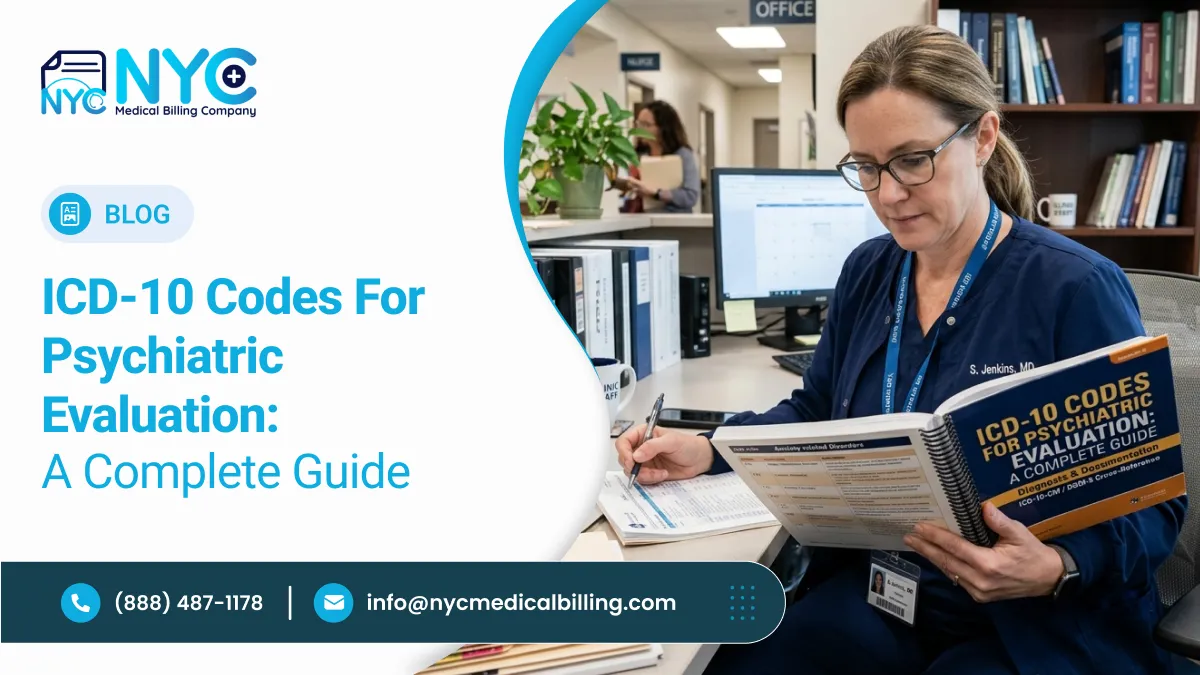
Psychiatric evaluations are often the starting point for identifying mental, behavioral, and emotional health conditions and developing an appropriate treatment plan. But from a claims perspective, documenting that an evaluation occurred is only part of the process. Providers must also select the CPT code that accurately represents the service and an ICD-10-CM diagnosis code that explains why the evaluation was medically necessary.
This distinction is important because there is no single ICD-10 code for psychiatric evaluation. ICD-10-CM codes describe the patient’s diagnosis, symptoms, or reason for the encounter, while CPT codes such as 90791 and 90792 describe the psychiatric diagnostic evaluation itself.
Incorrect code selection, insufficient documentation, diagnosis-procedure mismatches, duplicate services, and payer-specific limitations can all lead to claim denials or delayed reimbursement.
This guide explains the major psychiatric evaluation CPT codes, commonly associated ICD-10-CM diagnosis codes, documentation expectations, related behavioral health codes, and practical steps providers can take to reduce avoidable denials.
What Is a Psychiatric Diagnostic Evaluation?
A psychiatric diagnostic evaluation is a way to look closely at how a person’s feeling and behaving. It helps find out what is going on with their mind and how they are acting. This process is used to figure out the diagnosis and the best way to help them get better.
Depending on the patient’s presentation and clinical needs, an evaluation may address psychiatric symptoms, medical and psychiatric history, family and social history, current medications, substance use, psychosocial circumstances, mental status, risk factors, previous treatment, and the patient’s ability or willingness to participate in treatment.
Medicare explains that a psychiatric diagnostic evaluation is a biopsychosocial assessment. This psychiatric diagnostic evaluation may include history, psychiatric history, family history and social history. A mental status examination is also part of this diagnostic evaluation. After that a tentative diagnosis is established. The psychiatric diagnostic evaluation ends with checking whether the patient can. Is willing to participate in the proposed treatment plan.
When medical services are part of the assessment extra parts might include an exam that fits the patients condition, managing medications and checking or setting up lab tests or diagnostic studies. These elements help make sure the patient gets the care.
CPT 90791 vs. CPT 90792 for Psychiatric Evaluation
The two CPT codes most closely associated with a psychiatric diagnostic evaluation are 90791 and 90792.
| CPT Code | Service | General Use |
|---|---|---|
| 90791 | Psychiatric diagnostic evaluation | Diagnostic psychiatric evaluation without medical services |
| 90792 | Psychiatric diagnostic evaluation with medical services | Evaluation that includes appropriate medical services |
| 90785 | Interactive complexity | Add-on code when qualifying communication complexity is present |
The difference between 90791 and 90792 should not be reduced to the provider’s title alone. The service actually performed, the practitioner’s scope of practice, payer requirements, and documentation all matter.
CPT Code 90791
90791 represents a psychiatric diagnostic evaluation without medical services.
The service could include an evaluation of mental and emotional factors past mental health issues, current mental state symptoms someone is having level of risk and other details needed to figure out a diagnosis and a plan, for treatment.
It is commonly associated with initial behavioral health evaluations when medical services are not part of the diagnostic encounter.
CPT Code 90792
90792 represents a psychiatric diagnostic evaluation with medical services.
The evaluation may include medically appropriate assessment elements, medication-related evaluation, prescription management, and review or ordering of laboratory or other diagnostic studies when clinically indicated.
Documentation should focus on the component instead of treating 90792 as merely a higher‑level version of 90791. In my view documentation must capture the medical detail.
Medicare guidance recognizes both 90791 and 90792 as diagnostic evaluation services. Medicare guidance also places limits, on reporting these codes with certain other services on the same date.
Common ICD-10 Codes Used With Psychiatric Evaluations
The appropriate psychiatric evaluation diagnosis code depends entirely on the patient’s documented condition. Providers should report the diagnosis established through the evaluation when supported by the clinical record.
When a clear diagnosis has not been made the right code may be based on the symptoms, signs or the reason for the visit. This choice depends on the situation, in the clinic and the coding rules that’re in place.
The following are examples of ICD-10-CM codes commonly encountered in behavioral and psychiatric care.
| Condition | ICD-10-CM Code | Description |
|---|---|---|
| Major depressive disorder | F32.0 | Major depressive disorder, single episode, mild |
| Major depressive disorder | F32.1 | Major depressive disorder, single episode, moderate |
| Major depressive disorder | F32.2 | Major depressive disorder, single episode, severe without psychotic features |
| Recurrent depression | F33.0 | Major depressive disorder, recurrent, mild |
| Recurrent depression | F33.1 | Major depressive disorder, recurrent, moderate |
| Generalized anxiety disorder | F41.1 | Generalized anxiety disorder |
| Panic disorder | F41.0 | Panic disorder without agoraphobia |
| Unspecified anxiety | F41.9 | Anxiety disorder, unspecified |
| PTSD | F43.10 | Post-traumatic stress disorder, unspecified |
| Adjustment disorder | F43.20 | Adjustment disorder, unspecified |
| Bipolar I disorder | F31.9 | Bipolar I disorder, unspecified |
| Schizophrenia | F20.9 | Schizophrenia, unspecified |
| ADHD | F90.9 | Attention-deficit hyperactivity disorder, unspecified type |
| OCD | F42.9 | Obsessive-compulsive disorder, unspecified |
| Insomnia | F51.01 | Primary insomnia |
| Mental disorder, unspecified | F99 | Mental disorder, not otherwise specified |
These codes should never be selected simply because they are commonly reimbursed with a psychiatric evaluation. The diagnosis submitted on the claim should accurately represent the condition evaluated and supported in the medical record.
Understanding ICD-10-CM F Codes in Psychiatric Care
A large proportion of behavioral health diagnoses are found in Chapter 5 of ICD-10-CM. This chapter includes codes that start with the letter F.
Major categories include:
F20–F29: schizophrenia, schizotypal, delusional, and other psychotic disorders
F30–F39: mood and affective disorders
F40–F48: anxiety, stress-related, dissociative, somatoform, and related disorders
F50–F59: behavioral syndromes associated with physiological disturbances and physical factors
F60–F69: disorders of adult personality and behavior
F70–F79: intellectual disabilities
F80–F89: disorders of psychological development
F90–F98: behavioral and emotional disorders with onset usually occurring in childhood or adolescence
Accurate specificity matters. For example writing depression” when the clinician has clearly identified the episode whether it is a first or recurrent episode, the severity level and if there are any psychotic features can lead to a coding that does not match the actual details in the record.
Providers should take care to ensure that their assessment and diagnosis fully reflect the clinical condition being treated. This means using detailed language that matches the information the clinician has gathered. The documentation should support the coding being used so nothing important gets missed.
What If a Final Psychiatric Diagnosis Has Not Been Established?
Not every psychiatric evaluation produces a definitive diagnosis during the first encounter.
A patient might show signs like anxiety feeling sad changes in behavior trouble sleeping, worries, about memory or other mental health concerns. These symptoms often need testing and review before a clear diagnosis can be made.
In some cases depending on the situation and the coding rules it may be right to use a code that describes the symptom itself of a full disorder.
Examples include:
| ICD-10-CM Code | Description |
|---|---|
| R45.2 | Unhappiness |
| R45.4 | Irritability and anger |
| R45.82 | Worries |
| R41.0 | Disorientation, unspecified |
| R41.3 | Other amnesia |
Providers should avoid assigning a psychiatric disorder solely to create a payable diagnosis. The diagnosis should reflect what is clinically known and documented at the time of the encounter.
Interactive Complexity and CPT 90785
Some psychiatric encounters involve communication challenges that go beyond the usual complexity of a diagnostic evaluation.
In qualifying circumstances, CPT 90785 — interactive complexity may be reported as an add-on service with 90791 or 90792.
Examples recognized in Medicare guidance can include situations involving difficult communication among participants, caregiver behavior that interferes with treatment-plan implementation, certain mandated-report situations, or communication barriers requiring specific adaptations.
Simply spending additional time with a difficult patient does not automatically justify 90785. Documentation should identify the specific communication factor and explain why interactive complexity applied.
Related Psychiatric and Behavioral Health CPT Codes
Psychiatric evaluations often lead to ongoing psychotherapy or other behavioral health services. Providers should distinguish the initial diagnostic service from subsequent treatment.
Common psychotherapy codes include:
| CPT Code | Service |
|---|---|
| 90832 | Individual psychotherapy, approximately 30 minutes |
| 90834 | Individual psychotherapy, approximately 45 minutes |
| 90837 | Individual psychotherapy, approximately 60 minutes |
| 90833 | Psychotherapy add-on with E/M, approximately 30 minutes |
| 90836 | Psychotherapy add-on with E/M, approximately 45 minutes |
| 90838 | Psychotherapy add-on with E/M, approximately 60 minutes |
| 90846 | Family psychotherapy without the patient present |
| 90847 | Family psychotherapy with the patient present |
| 90853 | Group psychotherapy |
| 90839 | Psychotherapy for crisis, first 60 minutes |
| 90840 | Each additional 30 minutes of crisis psychotherapy |
Psychotherapy codes 90833, 90836, and 90838 are add-on codes used with an appropriate E/M service rather than as standalone psychotherapy codes.
Providers should also be careful with crisis services. Medicare states that CPT 90839 and 90840 should not be reported with psychiatric diagnostic evaluation codes 90791 or 90792 for the same service.
Psychiatric Evaluation and E/M Codes
A frequent coding mistake happens when an E/M service is billed with 90791 or 90792 without checking if separate reporting is allowed. Medicare’s NCCI guidance says that E/M codes should not be reported separately with diagnostic codes 90791 or 90792 during the same encounter.
The situation changes for medication‑management visits when a physician or another qualified healthcare professional gives an E/M service together with psychotherapy.
In those circumstances an appropriate E/M code can be paired with a psychotherapy add‑on code like 90833, 90836 or 90838 long as all requirements are met.
The medical record should separately support the E/M work and psychotherapy service.
Documentation Requirements for Psychiatric Evaluation
Strong documentation is one of the most effective defenses against psychiatric evaluation claim denials.
A complete record should reflect the actual clinical work performed rather than simply listing a diagnosis and CPT code.
Depending on the encounter useful documentation may include the patients complaint and reason, for referral. It should also cover psychiatric symptoms. Relevant medical and psychiatric history must be recorded. Medications being taken need to be listed. Previous treatment history is important. Family and social history should be included. Substance-use history is relevant when applicable.
A mental status examination must be done. Risk and safety assessment is necessary. The diagnostic impression should be stated. Treatment recommendations need to be provided. A follow-up plan should be outlined.
For 90792, documentation should additionally demonstrate the medical services that support use of the code.
For 90785, the record should explain the qualifying interactive complexity and the adaptations or additional communication work required.
Can CPT 90791 or 90792 Be Billed More Than Once?
Psychiatric diagnostic evaluation is usually linked to the start of an illness a suspected illness or a new episode of care.. That does not mean the code can only be used one time for a patient.
Medicare guidance allows for another evaluation when it is medically needed. This includes an episode of illness certain hospital admissions or readmissions or when the first evaluation takes more than one visit.
Still any repeated diagnostic interviews must have documentation showing medical necessity. Some Medicare contractors set limits on how these evaluations can be billed. Providers should always check the rules from the Medicare Administrative Contractor and any commercial payer policies before sending in claims, for repeated evaluations.
Common Psychiatric Evaluation Claim Denials
Even when the evaluation itself is medically appropriate, coding and documentation problems can lead to payment delays.
Diagnosis Does Not Support Medical Necessity
A payer may deny a claim when the submitted ICD-10-CM code does not adequately support the psychiatric service.
Prevention: Make sure the diagnosis accurately reflects the condition assessed and is supported by the clinical documentation.
90791 and 90792 Are Reported Incorrectly
Using 90792 when the record does not demonstrate the medical component can create a coding discrepancy.
Prevention: Select the code according to the service actually performed and document the medical component when reporting 90792.
Duplicate or Excessive Diagnostic Evaluations
If you keep billing 90791 or 90792 again but you do not explain why another diagnostic evaluation was required the payer may decide to deny the claim or investigate the billing.
To avoid this problem make sure you clearly write down an episode a big change, in the patient’s condition a readmission, an incomplete first assessment or any other reason that the payer knows is valid.
Incorrect Same-Day Code Combination
Reporting a psychiatric diagnostic evaluation with another service that is bundled, mutually exclusive, or otherwise restricted can result in a denial.
Prevention: Review current CPT instructions, NCCI edits, payer policies, and applicable Medicare coverage guidance before submitting same-day services.
Missing or Invalid Diagnosis Code
Medicare guidance states that a claim without a valid ICD-10-CM diagnosis code may be returned as incomplete.
Prevention: Confirm that every psychiatric claim contains a valid diagnosis code that accurately represents the reason the service was provided.
Insufficient Documentation
A brief note stating “psychiatric evaluation completed” usually does not demonstrate the scope and medical necessity of a comprehensive psychiatric diagnostic evaluation.
Prevention: Document the clinically relevant history, mental status findings, diagnostic reasoning, risk assessment when applicable, treatment recommendations, and other elements necessary to support the billed service.
How to Reduce Psychiatric Evaluation Denials
Clean psychiatric claims begin with accurate clinical documentation.
Before submitting a claim, providers should confirm that the CPT code matches the actual service, the ICD-10-CM diagnosis reflects the patient’s documented condition, the practitioner’s credentials and scope support the service, and any add-on codes meet their individual requirements.
It is equally important to verify payer-specific coverage. Medicare Administrative Contractors and commercial health plans may apply different medical-necessity requirements, frequency limitations, authorization rules, telehealth requirements, or documentation expectations.
A code that is technically valid does not automatically guarantee payment.
Psychiatric Evaluation Coding Example
Consider a patient referred for persistent anxiety, excessive worry, difficulty concentrating, sleep disturbance, and functional impairment.
The provider completes a psychiatric diagnostic evaluation, reviews psychiatric and psychosocial history, performs a mental status examination, evaluates risk, and determines that the patient meets the documented diagnostic criteria for generalized anxiety disorder.
A potential coding combination could be:
CPT: 90791 — Psychiatric diagnostic evaluation
ICD-10-CM: F41.1 — Generalized anxiety disorder
If an appropriately qualified practitioner instead performs a psychiatric diagnostic evaluation that includes qualifying medical services, 90792 may be appropriate when supported by the documentation and payer requirements.
The important point is that the CPT code describes what was performed, while the ICD-10-CM code describes why the service was clinically necessary.
Final Thoughts
Accurate psychiatric evaluation coding requires more than choosing between CPT 90791 and 90792. Providers must connect the service performed to an appropriate, documented ICD-10-CM diagnosis while considering medical necessity, practitioner scope, same-day coding rules, payer requirements, and documentation quality.
For most psychiatric diagnostic evaluations, 90791 represents an evaluation without medical services, while 90792 represents an evaluation that includes medical services. Add-on CPT 90785 may apply when qualifying interactive complexity is documented.
The ICD-10-CM code should then reflect the patient’s actual diagnosis or, when appropriate under applicable coding rules, the signs or symptoms known at the time of the encounter.
Because CPT, ICD-10-CM, NCCI edits, Medicare coverage policies, and commercial payer requirements can change, healthcare organizations should verify the code set and payer policy applicable to the date of service before submitting claims.
A consistent approach—accurate diagnosis selection, procedure-to-diagnosis alignment, detailed documentation, and payer-specific verification—can help doctors, hospitals, clinics, and behavioral health providers submit cleaner psychiatric evaluation claims and reduce preventable denials.