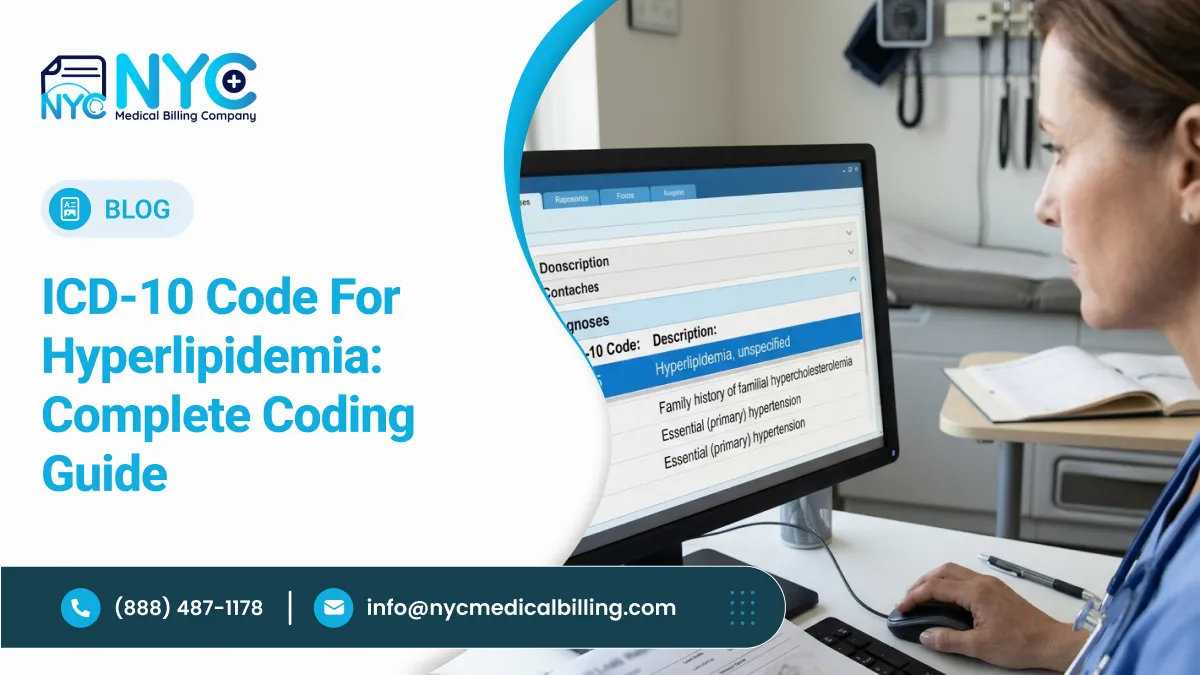
Hyperlipidemia is a condition that shows up in care, cardiology and internal medicine. Doctors often check cholesterol levels adjust medications and look at heart disease risk. You might wonder why the code matters. When it comes to billing the correct diagnosis code must match exactly how the lipid problem is written down.
The ICD‑10 code for hyperlipidemia when it is not specified is E78.5. There are types of hyperlipidemia—such as mixed hyperlipidemia, high cholesterol alone or inherited high cholesterol—each, with its own code.
These codes show differences in the patient’s condition.
Using the code can cause problems. Claims might get rejected providers might get asked to send paperwork or payment could be delayed. This is especially true when insurance companies need diagnoses to cover treatment.
This guide covers the often used ICD-10 codes for hyperlipidemia. It helps explain how to tell them and what details doctors should include in notes to make sure billing is correct.
What Is the ICD-10 Code for Hyperlipidemia?
E78.5 – Hyperlipidemia, unspecified is the ICD-10-CM code used when a physician diagnoses hyperlipidemia without identifying a particular type.
The code belongs to category E78, which covers disorders of lipoprotein metabolism and other lipidemias. It is a billable diagnosis code under the ICD-10-CM classification system.
| Code Detail | Information |
|---|---|
| ICD-10-CM Code | E78.5 |
| Official Description | Hyperlipidemia, unspecified |
| Category | E78 |
| Billable Code | Yes |
| ICD-10-CM Chapter | Endocrine, nutritional and metabolic diseases |
For example, a physician might look at a patient who is taking medicine to lower cholesterol. In the assessment the physician could write “hyperlipidemia.” If there isn’t a type of lipid disorder mentioned then using the code E78.5 is the right choice.
However, the presence of more detailed diagnostic information can change the code selection.
The code E78.5 is still correct for the year 2027 ICD-10-CM time frame. This time frame starts on October 1 2026, and ends on September 30 2027.
Common ICD-10 Codes for Hyperlipidemia
Hyperlipidemia is a term that covers many different lipid problems. Choosing the right code means finding the condition that the doctor has written down.
The table below shows the often used hyperlipidemia ICD-10 codes, for 2027.
| ICD-10-CM Code | Diagnosis Description |
|---|---|
| E78.5 | Hyperlipidemia, unspecified |
| E78.2 | Mixed hyperlipidemia |
| E78.00 | Pure hypercholesterolemia, unspecified |
| E78.1 | Pure hyperglyceridemia |
| E78.010 | Homozygous familial hypercholesterolemia |
| E78.011 | Heterozygous familial hypercholesterolemia |
| E78.019 | Familial hypercholesterolemia, unspecified |
| E78.49 | Other hyperlipidemia |
These diagnoses should not be treated as interchangeable. Each represents a particular condition or level of diagnostic specificity.
Unspecified Hyperlipidemia – E78.5
E78.5 is used whenever the provider confirms hyperlipidemia but does not note the type.
For example, a patient who visits for a follow‑up might have a history of high lipid levels and be, on continuous medication. When the provider records the term hyperlipidemia, E78.5 becomes the suitable code.
Mixed Hyperlipidemia – E78.2
E78.2 is the ICD-10 code for hyperlipidemia. This condition means there are issues with cholesterol levels and triglyceride levels, in the blood. The code must only be used when the doctor has clearly diagnosed hyperlipidemia.
It is not enough to see high cholesterol and high triglycerides on a lipid panel. Coders must not assign E78.2 automatically based on lab results. The diagnosis must come from the physician. The documented diagnosis must support the code.
Pure Hypercholesterolemia – E78.00
E78.00 indicates hypercholesterolemia when the provider does not determine a more specific family type.
This condition mainly means cholesterol, not a mix of many other lipid problems.
Pure Hyperglyceridemia – E78.1
E78.1 represents pure hyperglyceridemia, a condition characterized primarily by elevated triglycerides.
The code should reflect the physician’s diagnosis rather than an independent interpretation of triglyceride test results.
Familial Hypercholesterolemia – E78.010, E78.011, and E78.019
Familial hypercholesterolemia is an inherited condition that causes high levels of LDL, which is known as “bad” cholesterol. This condition can make a person more likely to get heart disease when they are still young.
ICD-10-CM has codes for both homozygous and heterozygous familial hypercholesterolemia. It also includes a code when the type is not known. Getting the right code is important because it helps make sure the diagnosis is correct and it helps with the treatment and billing.
Doctors should write down the type of familial hypercholesterolemia if they can. If the condition is known but the type is not clear then the code E78.019 – hypercholesterolemia unspecified might be the right choice. This depends on the ICD-10-CM coding guidelines that’re, in place.
Other Hyperlipidemia – E78.49
E78.49 covers other specified hyperlipidemia conditions, including familial combined hyperlipidemia.
It should not replace E78.5 simply because a physician provides additional clinical information. Code selection must follow the documented diagnosis and the ICD-10-CM classification.
Hyperlipidemia vs. Hypercholesterolemia: ICD-10 Coding Differences
Although high levels of fat in the blood and high cholesterol are connected they do not always mean the thing.
High levels of fat in the blood is a term that includes problems with fats in the blood, such, as cholesterol and triglycerides.
High cholesterol specifically means the cholesterol levels are too high.
This difference changes which ICD-10-CM code should be used.
| Condition | ICD-10-CM Code |
|---|---|
| Unspecified hyperlipidemia | E78.5 |
| Mixed hyperlipidemia | E78.2 |
| Pure hypercholesterolemia, unspecified | E78.00 |
A patient comes in with lab results showing LDL cholesterol but normal triglycerides. The doctor looks at the numbers. Writes down pure hypercholesterolemia. In this case using code E78.00 makes sense because that’s what the doctor diagnosed.
Now take a patient. This one has levels of both cholesterol and triglycerides. The doctor reviews the results. Decides it’s mixed hyperlipidemia. Then the correct code to use is E78.2.
The key point here is that coders must not decide what kind of hyperlipidemia is present, on their own. They have to go by the provider’s diagnosis. Coders should always follow the doctor’s written diagnosis and the ICD-10-CM coding guidelines.
Documentation Requirements for Hyperlipidemia ICD-10 Coding
Clear clinical documentation helps you pick the diagnosis code and keeps the billing process smooth so clinical documentation remains essential.
For physicians who treat patients with lipid disorders the medical record must clearly identify the diagnosed condition and explain why it matters to the encounter; the medical record should also note any treatment plan.
The following documentation elements are particularly useful.
1. Specific diagnosis
The assessment should identify the type of lipid disorder whenever it has been established.
For example, documenting “mixed hyperlipidemia” provides greater diagnostic clarity than recording “high cholesterol” when mixed hyperlipidemia is the confirmed condition.
2. Relevant laboratory findings
Cholesterol, LDL, HDL, and triglyceride results can support clinical decisions.
Providers should record findings that influence diagnosis, treatment, or follow-up care. Laboratory results alone, however, do not authorize coders to establish an undocumented diagnosis.
3. Medication management
Documenting prescribed medications, dosage adjustments, treatment response, and medication-related concerns helps demonstrate how the condition is being managed.
4. Associated conditions
Patients with hyperlipidemia may also have diabetes, hypertension, or cardiovascular disease.
When these conditions affect the encounter, the physician should document their assessment and management separately.
5. Follow-up and monitoring
The note needs to say why more testing or checking is needed especially if a doctor changes medicine or looks at a treatment that isn’t working well.
At NYC Medical Billing, clear diagnostic documentation is an important part of preventing coding errors.
Common Hyperlipidemia Coding Mistakes to Avoid
Even a familiar diagnosis can create billing problems when the code does not match the medical record.
The following errors deserve attention during claim reviews.
Using E78.5 When a Specific Diagnosis Is Documented
E78.5 is appropriate for unspecified hyperlipidemia, but it should not automatically replace a more specific code.
If the physician documents mixed hyperlipidemia, E78.2 generally provides a more accurate representation of the diagnosis.
Assigning a Diagnosis From Laboratory Results
An elevated lipid panel does not automatically mean hyperlipidemia.
A coder reviewing cholesterol or triglyceride levels should not alone diagnose a lipid disorder.
For outpatient encounters uncertain diagnoses must not be reported as confirmed conditions. If the documentation does not establish the diagnosis coding should reflect the degree of certainty that the encounter supports.
Reporting Non-Billable Codes
Many ICD‑10‑CM entries point to categories or subcategories of full billable diagnoses.
For instance the code E78.01 points to the hypercholesterolemia subcategory yet it still needs a more specific billable code.
If you send a code the claim may be rejected.
Confusing Different Lipid Disorders
Mixed hyperlipidemia, hypercholesterolemia and familial hypercholesterolemia are different conditions and each has its own specific code.
Picking a code just because you’re used to the term might not match what’s actually written in the record. That can lead to diagnosis reporting.
It’s important to choose the code based on what’s documented not what sounds familiar.
Coding Conditions That Do Not Affect the Encounter
A diagnosis listed in the patients history is not automatically reportable on every outpatient claim. Just because a condition is in the record doesn’t mean it should be coded every time.
Under outpatient coding guidelines coexisting conditions should be reported when they require or affect care, treatment or management during the encounter. If the condition plays a role in what’s done during that visit then it should be included.
For hyperlipidemia ongoing assessment, monitoring or medication management may support reporting the condition. If the doctor is checking levels adjusting meds or managing the patient’s plan, for hyperlipidemia during the visit then it’s appropriate to report hyperlipidemia.
How Hyperlipidemia ICD-10 Codes Affect Medical Necessity
Correct diagnosis coding is especially important when physicians order lipid testing or provide ongoing treatment for cholesterol disorders.
A diagnosis code helps communicate why a service was performed, but it does not independently establish insurance coverage.
For example, a physician may order a lipid panel to evaluate a patient’s response to medication. The record should identify the condition being monitored and explain the reason for testing.
Under Medicare’s National Coverage Determination (NCD) 190.23 for Lipid Testing coverage is not automatic. It depends on the clinical situation and whether the testing meets the required medical necessity standards.
This policy covers lipid testing used to diagnose and manage lipid disorders and related health issues. It also talks about how testing can be done and the difference between testing done for diagnosis and testing done as routine screening.
For practices three things are especially important:
Diagnosis accuracy: The ICD-10-CM code that’s reported must match what the provider has documented as the patient’s diagnosis.
Testing frequency: If a patient is having lipid testing repeated it must follow the payer’s rules on how testing is allowed and meet medical necessity criteria.
Clinical justification: The medical record must clearly show why the testing was needed or why ongoing monitoring is still required.
Not all patients, with hyperlipidemia need the testing schedule. A patient who just had their medication changed might need frequent checks. Someone whose condition has stayed the same may not need testing often.
Billing teams should check the coverage rules. They shouldn’t assume that using a code like E78.5 or another lipid disorder code will always lead to payment.
Frequently Asked Questions About Hyperlipidemia ICD-10 Codes
What is the ICD-10 code for unspecified hyperlipidemia?
The ICD-10 code for unspecified hyperlipidemia is E78.5. It applies when the provider diagnoses hyperlipidemia without identifying a more specific form of the condition.
What is the ICD-10 code for mixed hyperlipidemia?
E78.2 is the ICD-10-CM code for mixed hyperlipidemia. It should be used when the physician documents this specific diagnosis.
Is E78.5 a billable diagnosis code?
Yes. E78.5 is a billable ICD-10-CM diagnosis code and remains valid for services reported under the FY 2027 code set.
What is the difference between E78.2 and E78.5?
E78.2 identifies mixed hyperlipidemia, while E78.5 represents unspecified hyperlipidemia. The correct code depends on the diagnosis established in the medical record.
What ICD-10 code is used for high cholesterol?
E78.00 is commonly used for documented pure hypercholesterolemia, unspecified. The correct code depends on the provider’s diagnostic wording and the applicable ICD-10-CM Index and Tabular List instructions.
Conclusion
Selecting the ICD-10 code for hyperlipidemia begins with a clear diagnosis. Even though E78.5 is used for hyperlipidemia, other types of hyperlipidemia need different ICD-10 codes.
Doctors can help with coding by making sure the documentation shows the lipid disorder, any related findings and the choices made about treatment. Staff members who handle billing should check that the codes are specific and that they meet the rules, from the insurance companies before sending in the claims.
For clinics that want to make sure their coding is correct and avoid billing mistakes that can be prevented NYC Medical Billing offers help with billing. This support focuses on making sure the documentation is correct the claims are processed properly. The money coming in is managed well.