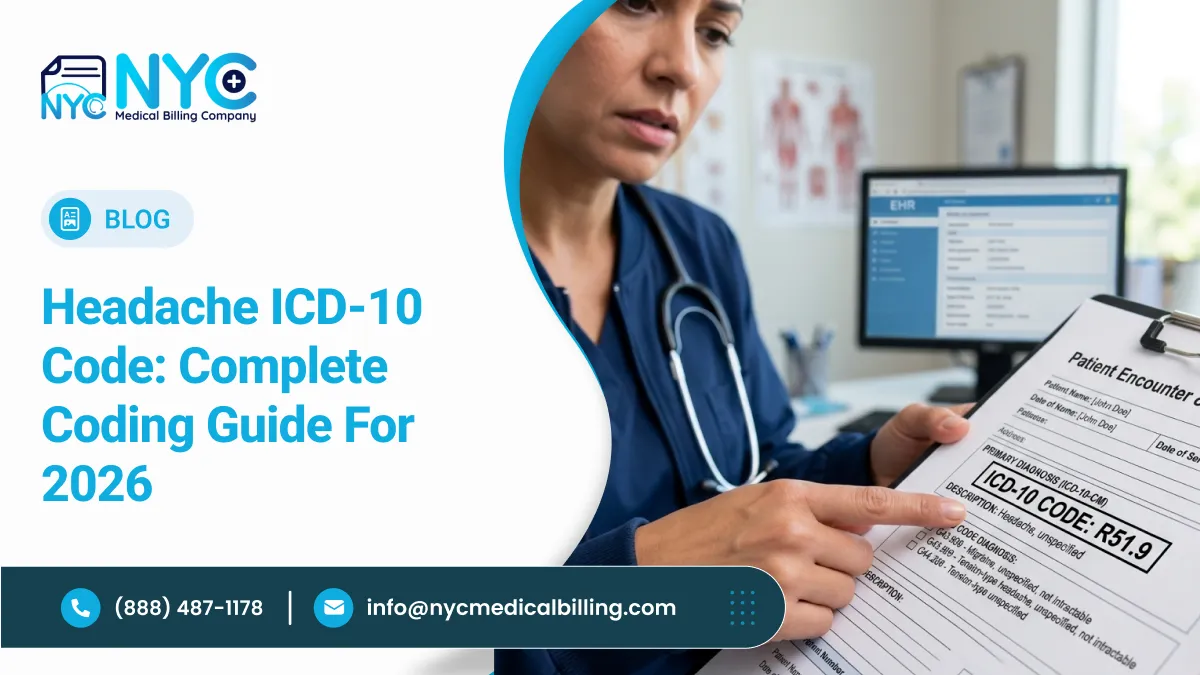
Headache is a reason why people go to primary care clinics, neurologists or emergency rooms. Yet not every headache gets the label. If someone has head pain they might be given an unspecified headache. If a person has frequent and intense attacks doctors might diagnose them with migraine, tension‑type headache or cluster headache.
These differences matter when picking an ICD‑10‑CM diagnosis code.
The common headache ICD‑10 code is R51.9, which means an unspecified headache. Still if a doctor finds a headache disorder a more precise code, from the G43 or G44 groups might be needed.
Accurate coding relies on what the provider writes down such as how the headache happens how long it lasts what other symptoms appear, how the treatment works and the confirmed diagnosis.
This guide explains the headache ICD‑10 codes that will be used in 2026 covering migraine and other headache disorders. It also talks about CPT codes, HCPCS codes, modifiers, documentation rules and common insurance denials so that doctors, hospitals and clinics can get coding right.
What Is the ICD-10 Code for Headache?
The ICD-10-CM code R51.9 — Headache, unspecified is used when a patient has headache symptoms but the provider has not established a more specific headache diagnosis.
For example, a patient may report persistent head pain during an initial appointment. If the physician evaluates the symptoms but cannot yet identify whether the patient has migraine or another headache condition, R51.9 may be appropriate.
Two diagnosis codes are available under the R51 headache category:
|
ICD-10-CM code |
Description |
When it applies |
|---|---|---|
|
R51.9 |
Headache, unspecified |
Headache without a more specific established diagnosis |
|
R51.0 |
Headache with orthostatic component, not elsewhere classified |
A positional headache associated with standing or sitting upright, when no more specific condition is established |
Both are billable codes. The parent category R51 is not billable by itself.
A key distinction is that R51.9 describes a symptom, not a confirmed migraine or other specific headache disorder. When a provider establishes a more definitive diagnosis, coding should reflect that condition according to the applicable coding guidelines.
Headache ICD-10 Codes: Quick Reference Table
The following codes cover common headache diagnoses encountered in outpatient practices, neurology clinics, and hospitals.
|
Headache condition |
ICD-10-CM code |
|---|---|
|
Unspecified headache |
R51.9 |
|
Orthostatic headache, NEC |
R51.0 |
|
Migraine without aura, not intractable, without status migrainosus |
G43.009 |
|
Migraine with aura, not intractable, without status migrainosus |
G43.109 |
|
Migraine, unspecified, without status migrainosus, not intractable |
G43.909 |
|
Migraine, unspecified, intractable, with status migrainosus |
G43.911 |
|
Chronic migraine without aura, not intractable, without status migrainosus |
G43.709 |
|
Chronic migraine without aura, intractable, without status migrainosus |
G43.719 |
|
Chronic migraine with aura, not intractable, without status migrainosus |
G43.E09 |
|
Tension-type headache, unspecified, not intractable |
G44.209 |
|
Chronic tension-type headache, not intractable |
G44.229 |
|
Episodic cluster headache, not intractable |
G44.019 |
|
Chronic cluster headache, not intractable |
G44.029 |
|
Medication overuse headache |
G44.40 |
|
Other complicated headache syndrome |
G44.59 |
These codes serve different clinical purposes. They should not be used interchangeably simply because the patient reports head pain.
Important 2026–2027 coding update
The federal FY 2026 ICD-10-CM code set applies to services from October 1, 2025, through September 30, 2026, including the applicable April 2026 update. FY 2027 codes became effective October 1, 2026.
For claims submitted after that date, use the code set applicable to the patient’s date of service, rather than relying solely on the calendar year in the article title. The current and previous code sets are published by CMS.
Migraine ICD-10 Codes for 2026
Migraine is a neurological disorder that can cause recurring headaches, nausea, vomiting, and sensitivity to light or sound. Some patients also experience temporary visual or sensory disturbances known as aura.
Unlike an unspecified headache, migraine has a dedicated ICD-10-CM category: G43 — Migraine.
Selecting the correct migraine code requires attention to several details:
-
Whether the patient experiences aura
-
Whether the condition is episodic or chronic
-
Whether migraine is intractable or treatment-resistant
-
Whether status migrainosus is present
-
Whether a particular migraine subtype has been diagnosed
The G43 category includes several code families that account for these clinical differences.
ICD-10 Codes for Migraine Without Aura
Migraine without aura involves recurring migraine attacks without preceding or accompanying aura symptoms.
|
ICD-10 code |
Diagnosis |
|---|---|
|
G43.001 |
Migraine without aura, not intractable, with status migrainosus |
|
G43.009 |
Migraine without aura, not intractable, without status migrainosus |
|
G43.011 |
Migraine without aura, intractable, with status migrainosus |
|
G43.019 |
Migraine without aura, intractable, without status migrainosus |
For example a patient who has repeated migraine attacks that get better with the medicine that the doctor gave and who does not have a lasting attack might get the code G43.009 when the doctor writes that the patient has migraine without aura.
But if the medicine does not work and the doctor says the migraine is hard to control then the code might be different.
ICD-10 Codes for Migraine With Aura
Migraine with aura involves temporary neurological symptoms that may include visual disturbances, tingling, or language difficulties.
|
ICD-10 code |
Diagnosis |
|---|---|
|
G43.101 |
Migraine with aura, not intractable, with status migrainosus |
|
G43.109 |
Migraine with aura, not intractable, without status migrainosus |
|
G43.111 |
Migraine with aura, intractable, with status migrainosus |
|
G43.119 |
Migraine with aura, intractable, without status migrainosus |
A patient who says they see flashing lights before a headache needs to get a medical check. Just having symptoms by themselves is not enough to say the person has a migraine, with aura. The doctor has to make sure and confirm it.
ICD-10 Codes for Unspecified Migraine
Sometimes a physician confirms migraine but does not document its particular subtype.
In such cases, the G43.9 family may apply.
|
ICD-10 code |
Diagnosis |
|---|---|
|
G43.901 |
Migraine, unspecified, not intractable, with status migrainosus |
|
G43.909 |
Migraine, unspecified, not intractable, without status migrainosus |
|
G43.911 |
Migraine, unspecified, intractable, with status migrainosus |
|
G43.919 |
Migraine, unspecified, intractable, without status migrainosus |
G43.909 is often used when a migraine diagnosis is made but there are no details to support a more specific code.
Providers should record any characteristics that are clinically confirmed. They should not choose a more specific code based only on guesses or assumptions.
Chronic Migraine ICD-10 Codes
Chronic migraine needs detailed records than a single migraine episode.
In terms chronic migraine usually means having headaches on at least fifteen days each month for longer than three months and having migraine signs on at least eight days each month according to established diagnostic rules.
This difference matters for migraine because some prevention treatments, like botulinum toxin injections require proof of headache frequency and past treatment history to be covered.
Chronic Migraine Without Aura
|
ICD-10 code |
Diagnosis |
|---|---|
|
G43.701 |
Chronic migraine without aura, not intractable, with status migrainosus |
|
G43.709 |
Chronic migraine without aura, not intractable, without status migrainosus |
|
G43.711 |
Chronic migraine without aura, intractable, with status migrainosus |
|
G43.719 |
Chronic migraine without aura, intractable, without status migrainosus |
Chronic Migraine With Aura
| ICD-10 code |
Diagnosis |
|---|---|
|
G43.E01 |
Chronic migraine with aura, not intractable, with status migrainosus |
|
G43.E09 |
Chronic migraine with aura, not intractable, without status migrainosus |
|
G43.E11 |
Chronic migraine with aura, intractable, with status migrainosus |
|
G43.E19 |
Chronic migraine with aura, intractable, without status migrainosus |
The G43.E family provides dedicated codes for chronic migraine with aura. These codes require a complete billable child code rather than the parent G43.E designation.
A patient has headaches, on 18 days each month. At least eight of those days include symptoms of migraine. The doctor diagnoses migraine without aura. The physician also notes that earlier preventive treatments did not work. There is no sign of status migrainosus. If the condition is described as intractable then code G43.719 may be used.
The medical record should explain the treatment history supporting the diagnosis.
What Is Status Migrainosus?
Status migrainosus is a type of migraine that lasts than 72 hours and follows certain medical guidelines. This condition can be difficult to handle.
Often needs immediate medical attention. Symptoms such, as head pain ongoing vomiting or signs of dehydration make it even more serious and call for urgent treatment.
ICD-10-CM distinguishes migraine with status migrainosus from migraine without it.
For example:
|
Clinical diagnosis |
ICD-10 code |
|---|---|
|
Migraine without aura, not intractable, without status migrainosus |
G43.009 |
|
Migraine without aura, not intractable, with status migrainosus |
G43.001 |
|
Migraine without aura, intractable, with status migrainosus |
G43.011 |
The doctor must confirm status migrainosus. Coders should not assign status migrainosus simply because a patient says a headache has lasted days.
Similarly intractable usually means treatment- migraine. Intractable should be supported by the doctors diagnosis and relevant treatment history.
Tension Headache ICD-10 Codes
Tension-type headaches often feel like a pressing or tightening sensation that surrounds the forehead, temples or the back of the head.
Tension-type headaches may come as episodes or may become chronic. A clinical evaluation is needed to separate tension-type headaches from migraine and other conditions.
The ICD-10 codes, for tension headaches are found in the G44.2 category.
|
ICD-10 code |
Description |
|---|---|
|
G44.201 |
Tension-type headache, unspecified, intractable |
|
G44.209 |
Tension-type headache, unspecified, not intractable |
|
G44.211 |
Episodic tension-type headache, intractable |
|
G44.219 |
Episodic tension-type headache, not intractable |
|
G44.221 |
Chronic tension-type headache, intractable |
|
G44.229 |
Chronic tension-type headache, not intractable |
G44.209 is the code when a provider writes that a patient has tension‑type headache but does not say whether the tension‑type headache comes in episodes or is constant and does not say the tension‑type headache is intractable.
For example a patient says that they feel tightness, around the forehead again and again after working hours. After the doctor checks the patient the doctor says the patient has tension‑type headache and the tension‑type headache is not intractable.
G44.219 may be appropriate.
The diagnosis should reflect the clinical assessment rather than an assumption that stress or computer use automatically means tension headache.
Cluster Headache ICD-10 Codes
Cluster headaches cause usually one-sided pain often focused around the eye or temple area.
These episodes can come with symptoms like eyes a stuffy nose, drooping eyelid or a feeling of restlessness.
The ICD-10-CM code, for cluster headache is G44.0.
|
ICD-10 code |
Description |
|---|---|
|
G44.001 |
Cluster headache syndrome, unspecified, intractable |
|
G44.009 |
Cluster headache syndrome, unspecified, not intractable |
|
G44.011 |
Episodic cluster headache, intractable |
|
G44.019 |
Episodic cluster headache, not intractable |
|
G44.021 |
Chronic cluster headache, intractable |
|
G44.029 |
Chronic cluster headache, not intractable |
For example a patient who has one‑side headaches that come in repeating clusters could be given the diagnosis of episodic cluster headache. If those episodes are not very difficult to manage the code G44.019 might be used.
When the medical record shows a long‑term pattern the correct chronic cluster headache code should be chosen instead.
Other Headache ICD-10 Codes Providers Should Know
Not every headache falls into the migraine, tension-type or cluster categories.
Some happen because of medicine use, injury or another health problem. Others are known as headache syndromes.
| ICD-10 code | Description |
|---|---|
|
G44.40 |
Drug-induced headache, not elsewhere classified, not intractable |
|
G44.41 |
Drug-induced headache, not elsewhere classified, intractable |
|
G44.52 |
New daily persistent headache (NDPH) |
|
G44.59 |
Other complicated headache syndrome |
|
G44.86 |
Cervicogenic headache |
|
G44.89 |
Other headache syndrome |
|
G44.309 |
Post-traumatic headache, unspecified, not intractable |
|
G44.329 |
Chronic post-traumatic headache, not intractable |
|
G97.1 |
Other reaction to spinal and lumbar puncture |
Medication Overuse Headache
Patients who frequently use acute headache medications may develop medication overuse headache.
The coding depends on the provider’s diagnosis and the applicable drug-induced headache classification. G44.40 or G44.41 may be appropriate depending on documented intractability.
When an adverse drug effect is involved, the relevant medication code may also be required under ICD-10-CM guidelines.
Cervicogenic Headache
Cervicogenic headache is linked to problems in the spine or neck.
The code G44.86 is used to identify Cervicogenic headache when a qualified provider makes the diagnosis.
If a separate underlying cervical condition is found any extra diagnosis codes, for headache must follow the relevant tabular instructions and the documented clinical findings.
Post-Traumatic Headache
Post-traumatic headaches can appear after a head injury, such as a concussion.
Physician would write down how the head injury is linked to the -traumatic headaches, what the post-traumatic headache pattern looks like and whether the post-traumatic headaches are short‑term or long‑term.
Extra injury or sequela coding might be needed depending on the situation and the rules, in ICD‑10‑CM.
ICD-10 Codes for Secondary Headaches
A secondary headache happens because of another health problem, an injury, an infection or a change in the bodys function.
Unlike headache problems the main issue causing the headache might be the most important thing to treat.
Some examples are headaches that come with sinus infections, high blood pressure, a head injury or problems, inside the skull.
|
Related diagnosis |
ICD-10-CM code |
Coding consideration |
|---|---|---|
|
Acute maxillary sinusitis, unspecified |
J01.00 |
Use when established by the provider |
|
Essential hypertension |
I10 |
Do not assume hypertension caused the headache |
|
Concussion without loss of consciousness, initial encounter |
S06.0X0A |
Use when the documented injury supports it |
|
Cervicalgia |
M54.2 |
For clinically documented neck pain |
|
Intracranial hypertension, unspecified |
G93.2 |
Use when specifically diagnosed |
|
Trigeminal neuralgia |
G50.0 |
A separate facial pain condition, not a generic headache code |
|
Nausea |
R11.0 |
Report separately when supported and appropriate |
|
Dizziness and giddiness |
R42 |
Report when independently relevant |
These are related diagnoses, not interchangeable headache codes.
For example, a patient with elevated blood pressure and headache does not automatically have a headache caused by hypertension. The provider must establish the relationship when it affects diagnosis selection.
The same applies to sinus headaches. Facial pressure alone does not confirm sinusitis.
When an underlying cause is established, follow the relevant sequencing instructions and determine whether the headache itself warrants separate reporting.
Headache ICD-10 Coding: When Should R51.9 Be Used?
One of the most frequent questions in headache coding is whether R51.9 should be assigned or replaced with a code from G43 or G44.
The distinction depends on the documented diagnosis.
|
Clinical documentation |
Potential code |
Explanation |
|---|---|---|
|
Patient reports headache; no specific diagnosis established |
R51.9 |
Unspecified headache |
|
Physician diagnoses migraine without aura, not intractable, without status migrainosus |
G43.009 |
Specific migraine diagnosis |
|
Physician diagnoses tension-type headache, unspecified, not intractable |
G44.209 |
Specific headache syndrome |
|
Physician diagnoses episodic cluster headache, not intractable |
G44.019 |
Specific cluster headache |
|
Physician documents orthostatic headache without a more specific established condition |
R51.0 |
Positional headache symptom |
A symptom code remains appropriate when the clinician has not established a definitive diagnosis.
However, reporting an unspecified headache in addition to a confirmed headache syndrome is generally unnecessary when the symptom is integral to that diagnosis. Applicable Excludes notes and coding conventions must also be followed.
The FY 2026 ICD-10-CM Official Guidelines explain the use of symptoms and signs in outpatient coding and distinguish confirmed diagnoses from uncertain ones.
CPT Codes Commonly Used for Headache Evaluation and Treatment
ICD-10-CM codes explain the patient’s diagnosis. Current Procedural Terminology (CPT) codes describe the medical services performed.
A headache diagnosis may support an office evaluation, imaging examination, injection, or another medically necessary treatment. However, the diagnosis does not automatically justify every procedure.
Evaluation and Management CPT Codes
| CPT code |
Service description |
|---|---|
|
99202 |
New patient office/outpatient E/M, straightforward complexity or applicable time |
|
99203 |
New patient office/outpatient E/M, low complexity or applicable time |
|
99204 |
New patient office/outpatient E/M, moderate complexity or applicable time |
|
99205 |
New patient office/outpatient E/M, high complexity or applicable time |
|
99212 |
Established patient office/outpatient E/M, straightforward complexity or applicable time |
|
99213 |
Established patient office/outpatient E/M, low complexity or applicable time |
|
99214 |
Established patient office/outpatient E/M, moderate complexity or applicable time |
|
99215 |
Established patient office/outpatient E/M, high complexity or applicable time |
|
99281–99285 |
Emergency department E/M services, depending on applicable requirements |
Office visit code selection should be based on the documented level of medical decision-making or qualifying total time, as permitted under the relevant E/M guidelines.
A patient experiencing a severe headache does not automatically qualify for a higher E/M code. The documented work must support the selected service level.
Diagnostic Imaging CPT Codes for Headaches
Diagnostic imaging may be necessary when a clinician suspects a secondary cause of headache or identifies concerning symptoms.
|
CPT code |
Description |
|---|---|
|
70450 |
CT head/brain without contrast |
|
70460 |
CT head/brain with contrast |
|
70470 |
CT head/brain without and with contrast |
|
70551 |
MRI brain without contrast |
|
70552 |
MRI brain with contrast |
|
70553 |
MRI brain without and with contrast |
|
70544 |
MR angiography of the head without contrast |
|
70545 |
MR angiography of the head with contrast |
|
70546 |
MR angiography of the head without and with contrast |
The choice of imaging depends on clinical findings, not simply the presence of a headache.
For example, routine neuroimaging may not be medically necessary for every patient with an established primary headache disorder and a normal neurological evaluation.
Providers should document relevant symptoms, examination findings, diagnostic concerns, and the reason for ordering the study.
Headache Treatment and Injection CPT Codes
Certain headache conditions may require procedural treatment when clinically appropriate.
|
CPT code |
Description |
Potential application |
|---|---|---|
|
64615 |
Chemodenervation of muscles innervated by facial, trigeminal, cervical spinal, and accessory nerves, bilateral |
Chronic migraine treatment |
|
64405 |
Injection of greater occipital nerve |
Selected headache or occipital neuralgia treatment |
|
64450 |
Injection of other peripheral nerve or branch |
Appropriate separately identified nerve block |
|
96372 |
Therapeutic, prophylactic, or diagnostic injection, subcutaneous or intramuscular |
Administration of qualifying injected medication |
|
96374 |
Therapeutic, prophylactic, or diagnostic intravenous push, single or initial substance/drug |
Appropriate IV medication administration |
|
96365 |
Intravenous infusion for therapy, prophylaxis, or diagnosis, initial, up to one hour |
Qualifying infusion services |
These codes should only be reported when the actual service meets CPT requirements.
For example, CPT 64450 is not a general-purpose headache injection code. It applies only when the documented procedure satisfies the description and coding rules for a peripheral nerve injection.
Likewise, drug administration services may be packaged or subject to facility-specific billing restrictions.
HCPCS Codes Relevant to Migraine Treatment
Some headache treatments involve separately reportable medications, particularly injections used for chronic migraine.
HCPCS Level II codes may identify qualifying drugs when payer rules permit separate reimbursement.
|
HCPCS code |
Description |
Relevant use |
|---|---|---|
|
J0585 |
OnabotulinumtoxinA, per unit |
Chronic migraine prophylaxis when coverage criteria are met |
|
J1885 |
Ketorolac tromethamine injection, per 15 mg |
Appropriate acute pain treatment when prescribed |
|
J2405 |
Ondansetron hydrochloride injection, per 1 mg |
Treatment of qualifying nausea or vomiting |
Drug selection, dosage, administered units, and wastage should be documented accurately.
Important: A medication’s HCPCS code does not establish coverage by itself. Some medications may be supplied through pharmacy benefits, packaged into another service, or restricted by payer policy.
Botox Billing for Chronic Migraine
Botulinum toxin treatment is an area where headache coding and reimbursement requirements deserve particular attention.
CPT 64615 may be used to report qualifying chemodenervation treatment, while HCPCS J0585 identifies onabotulinumtoxinA when separately reportable.
Documentation commonly includes:
-
Confirmed chronic migraine diagnosis
-
Number of headache days and migraine days per month
-
Duration and severity of headache episodes
-
Previous treatment history
-
Clinical justification for botulinum toxin
-
Injection sites and administered dosage
-
Treatment response during follow-up
-
Amount of medication used and discarded, when applicable
Medicare coverage articles for botulinum toxin injections identify relevant headache diagnoses and describe coverage requirements, which can vary by Medicare Administrative Contractor and policy.
Providers should review the applicable Local Coverage Determination (LCD) and billing article before treatment and claim submission.
Modifiers Used in Headache and Migraine Billing
Modifiers provide additional information about a reported service. They do not replace the diagnosis code or establish medical necessity.
The following modifiers may be relevant depending on the actual services performed.
|
Modifier |
Description |
Example of appropriate application |
|---|---|---|
|
25 |
Significant, separately identifiable E/M service |
A qualifying E/M service performed on the same day as a headache-related procedure |
|
26 |
Professional component |
Physician interpretation of eligible diagnostic imaging |
|
TC |
Technical component |
Technical portion of an eligible diagnostic study |
|
59 |
Distinct procedural service |
Separate qualifying procedures when supported by documentation and coding edits |
|
XE |
Separate encounter |
Distinct service performed during a separate encounter |
|
XS |
Separate structure |
Distinct service involving a separate organ or structure |
| JW | Drug amount discarded/not administered |
Applicable discarded medication from a single-dose container |
|
JZ |
Zero drug amount discarded |
Applicable separately payable single-dose medication with no discarded amount |
Modifier 25: When Is It Appropriate?
Consider a patient receiving a scheduled injection for migraine treatment. During the same appointment, the physician performs a significant, separately identifiable evaluation of a new neurological concern.
If the evaluation meets applicable E/M requirements, modifier 25 may be appropriate on the E/M code.
However, routine assessment associated with performing the injection does not automatically justify reporting an additional office visit.
CMS states that a separately identifiable E/M service must be supported by the documentation.
Modifier 59: Avoid Using It Just to Obtain Payment
Modifier 59 indicates a distinct procedural service under qualifying circumstances.
It should not be added simply because two services were denied when billed together.
For headache-related procedures, providers must verify that the documented circumstances support a separately reportable service and that the applicable National Correct Coding Initiative (NCCI) rules permit the modifier.
Where a more specific X modifier applies and is accepted by the payer, it may be preferable.
Common Headache and Migraine Medical Billing Denials
Even when the diagnosis is correct, headache-related claims can encounter payment problems because of medical necessity requirements, inaccurate coding, incomplete documentation, or payer-specific coverage limitations.
Headache imaging and migraine injections are particularly sensitive to these issues because certain services require detailed justification or prior authorization.
Common Claim Adjustment Reason Codes (CARCs)
|
Denial/adjustment code |
Meaning |
Common concern |
|---|---|---|
|
CO-16 |
Claim/service lacks information needed for adjudication |
Missing or incomplete required claim details |
|
CO-18 |
Duplicate claim or service |
Same service submitted more than once |
|
CO-50 |
Service not considered medically necessary by the payer |
Insufficient documentation or unmet coverage criteria |
|
CO-96 |
Non-covered charges |
Service excluded under applicable benefits or policy |
|
CO-97 |
Payment included in another service or procedure |
Separate payment not allowed due to bundling |
|
CO-197 |
Precertification, authorization, or notification absent |
Required authorization not obtained or recognized |
|
CO-119 |
Benefit maximum reached |
Plan frequency or benefit limits exceeded |
The CO prefix indicates contractual obligation when used in a remittance adjustment. CARC numbers themselves can also appear with other claim adjustment group codes, depending on the circumstances.
Official CARC definitions are available through CMS and X12.
1. Medical Necessity Denials: CO-50
A provider orders brain imaging for a patient experiencing frequent headaches.
The claim is denied because the payer determines that medical necessity has not been established.
Possible reasons include inadequate documentation of neurological findings, insufficient clinical indications, or failure to satisfy the payer’s imaging criteria.
How to reduce this problem: Document the clinical findings supporting the examination and verify relevant coverage requirements before ordering or submitting the service.
2. Bundled Service Denials: CO-97
A clinic reports an office visit and an injection during the same appointment.
The payer determines that the E/M service was included in the procedural service.
This may occur when the documented visit does not support separately identifiable evaluation and management work.
How to reduce this problem: Review the encounter, relevant CPT guidelines, and NCCI edits before adding modifier 25. The medical record should clearly support both services when reported separately.
3. Authorization Denials: CO-197
A patient receives a migraine treatment requiring prior authorization, but the authorization has expired or was not obtained.
The claim may be denied even when the treatment was clinically reasonable.
How to reduce this problem: Verify authorization requirements, approved units, dates, rendering provider, and treatment limitations before the service.
4. Non-Covered Service Denials: CO-96
Some headache treatments are excluded from certain insurance plans or subject to diagnosis restrictions.
For example, a particular procedure may be covered for one established neurological diagnosis but not for a nonspecific headache presentation.
How to reduce this problem: Review the patient’s coverage and applicable payer policy. Do not replace a correctly documented diagnosis with an unsupported one solely to secure reimbursement.
Remittance Advice Remark Codes (RARCs) Related to Headache Claims
Remark codes provide additional information about why a claim was processed, adjusted, or denied.
They may accompany CARCs on an electronic remittance advice.
|
Remark code |
Meaning |
Relevance to headache billing |
|---|---|---|
|
N115 |
Decision based on a Local Coverage Determination |
A headache treatment fails an applicable Medicare LCD requirement |
|
N386 |
Decision based on a National Coverage Determination |
A service is evaluated under an applicable national Medicare policy |
|
N130 |
Consult plan documents for restrictions |
Coverage or benefit limitations need review |
|
N54 |
Claim information inconsistent with authorized services |
Billed services do not match preauthorization information |
|
M15 |
Separately billed services are bundled |
A procedure is not separately payable |
|
M51 |
Missing, incomplete, or invalid procedure code |
Submitted procedure coding requires correction |
|
MA130 |
Claim incomplete or invalid and unprocessable |
Claim must be corrected and resubmitted |
These are examples of codes that may appear on relevant claims; they are not unique to headache treatment.
The complete code definitions and current status are maintained by X12.
A denial should never be worked solely from a CARC or RARC in isolation. Providers must also review the explanation of benefits, payer policy, documentation, and claim details.
Documentation Requirements for Accurate Headache ICD-10 Coding
A complete medical record makes it easier to support both diagnosis selection and the services provided.
For headache and migraine encounters, the clinical documentation should describe the patient’s presentation clearly enough to support the diagnosis established by the provider.
Essential Documentation Checklist
|
Documentation element |
Why it matters |
|---|---|
|
Headache onset |
Helps explain whether symptoms are new, recurrent, or changing |
|
Frequency |
Supports episodic or chronic headache classification |
|
Duration |
Important for migraine history and status migrainosus |
|
Pain location and characteristics |
Supports clinical evaluation and differential diagnosis |
|
Associated symptoms |
Provides clinical context for migraine and other headache disorders |
|
Aura status |
Relevant to selection of migraine subtype |
|
Neurological examination |
Supports diagnostic assessment and medical necessity |
|
Treatment history |
Helps establish response to therapy and potential intractability |
|
Confirmed diagnosis |
Determines appropriate ICD-10-CM classification |
|
Treatment plan |
Supports the medical services ordered or performed |
|
Prior authorization details |
Helps establish compliance with payer requirements |
For chronic migraine, a headache diary or equivalent clinical history may also support the patient’s reported headache frequency and treatment response.
A well-documented medical record does not guarantee reimbursement, but it helps demonstrate why a diagnosis and service were appropriate.
Headache Coding Examples for Physicians and Clinics
The following examples illustrate how diagnosis documentation influences code selection.
Example: Unspecified Headache During an Initial Visit
A 34-year-old patient visits a primary care clinic because of intermittent headaches over the past week.
The physician reviews the patient’s history and performs an examination but does not establish a specific headache disorder.
Potential ICD-10-CM code: R51.9 — Headache, unspecified.
The provider should not assign a migraine diagnosis simply because the patient reports moderate or severe pain.
How NYC Medical Billing Helps Providers Manage Headache-Related Claims
Headache and migraine services can involve several coding considerations within one encounter. A neurologist may evaluate a chronic condition, review previous treatment failures, administer an injection, or order diagnostic imaging.
Each service must be supported by the medical record and reported according to the appropriate coding and payer requirements.
NYC Medical Billing supports physicians, neurology practices, clinics, and healthcare organizations with diagnosis coding review, claims management, authorization coordination, and denial follow-up. The goal is to help providers reduce preventable billing problems while maintaining accurate claims.
Best Practices to Reduce Headache Coding Errors in 2026
Headache claims are easier to manage when documentation, diagnosis coding, and procedure reporting are reviewed together.
A few practical steps can make a meaningful difference.
1. Use the most specific established diagnosis. Select the appropriate migraine or headache syndrome code when the provider’s documentation supports it.
2. Avoid assuming clinical characteristics. Migraine aura, intractability, status migrainosus, and chronicity should be established in the clinical record.
3. Verify the code set by date of service. Confirm whether FY 2026 or FY 2027 ICD-10-CM applies.
4. Connect each procedure to its medical necessity. Imaging, injections, and other services should have documented clinical indications.
5. Review payer requirements before treatment. Certain migraine therapies require authorization, treatment history, or specific documentation.
6. Apply modifiers only when justified. Modifiers must reflect the actual service and the relevant coding rules.
7. Review denials by their underlying cause. A corrected claim, additional documentation, reconsideration, or formal appeal may be appropriate depending on the payer’s decision.
8. Keep clinical documentation consistent. The diagnosis, treatment plan, procedure details, and submitted claim should not contradict one another.
These practices help reduce avoidable rework and support more accurate reimbursement without adding unnecessary steps to clinical care.
Frequently Asked Questions About Headache ICD-10 Codes
1. What is the ICD-10 code for headache in 2026?
The primary ICD-10-CM code for unspecified headache is R51.9. It is used when a patient has headache symptoms without a more specific diagnosis established by the provider. Other codes may apply for migraine, tension-type headache, or cluster headache.
2. What is the ICD-10 code for migraine?
Migraine codes are found in category G43. For example, G43.909 represents unspecified migraine, not intractable, without status migrainosus. The correct code depends on the documented migraine subtype, intractability, and status migrainosus.
3. Can R51.9 be used for chronic headaches?
R51.9 may be appropriate for chronic daily headache when no more specific headache disorder has been established and the code is supported by the documentation. However, if a provider diagnoses chronic migraine or chronic tension-type headache, the appropriate specific code should generally be used.
4. What is the ICD-10 code for tension headache?
G44.209 represents tension-type headache, unspecified, not intractable. Other codes in the G44.2 category describe episodic, chronic, and intractable tension-type headaches.
5. What is the ICD-10 code for severe headache?
There is no separate ICD-10-CM diagnosis code simply for a severe headache. The code depends on the clinician’s diagnosis. If no specific headache disorder has been established, R51.9 may be appropriate. Severity alone does not establish migraine or intractability.
6. What is the difference between R51.9 and G43.909?
R51.9 describes an unspecified headache symptom. G43.909 describes a diagnosed migraine of unspecified subtype that is not intractable and does not involve status migrainosus. The distinction is whether migraine has been established as a diagnosis.
7. Which CPT codes are commonly used for migraine treatment?
Depending on the services provided, codes may include office E/M codes such as 99213 and 99214, CPT 64615 for qualifying chemodenervation treatment, and CPT 64405 for an appropriate greater occipital nerve injection. Medical necessity and payer coverage must be verified.
8. Why are migraine treatment claims denied?
Common reasons include insufficient medical necessity documentation, missing prior authorization, incorrect diagnosis coding, exceeded benefit limits, and bundled services. The specific reason should be verified using the payer’s remittance codes and policy.
Final Thoughts
Choosing the right headache ICD-10 code starts with understanding what the provider has actually diagnosed.
R51.9 remains appropriate for an unspecified headache, but patients with confirmed migraine, tension-type headache, cluster headache, or another headache syndrome may require more specific diagnosis codes.
For physicians and healthcare organizations, accurate diagnosis coding is only part of the process. Procedure documentation, medical necessity, payer coverage criteria, and correct modifier use also influence whether a claim is processed successfully.
NYC Medical Billing helps healthcare providers navigate these requirements through medical billing support, coding review, and denial management services. By keeping clinical documentation and claim information aligned, practices can spend less time correcting preventable billing errors and more time focused on patient care.