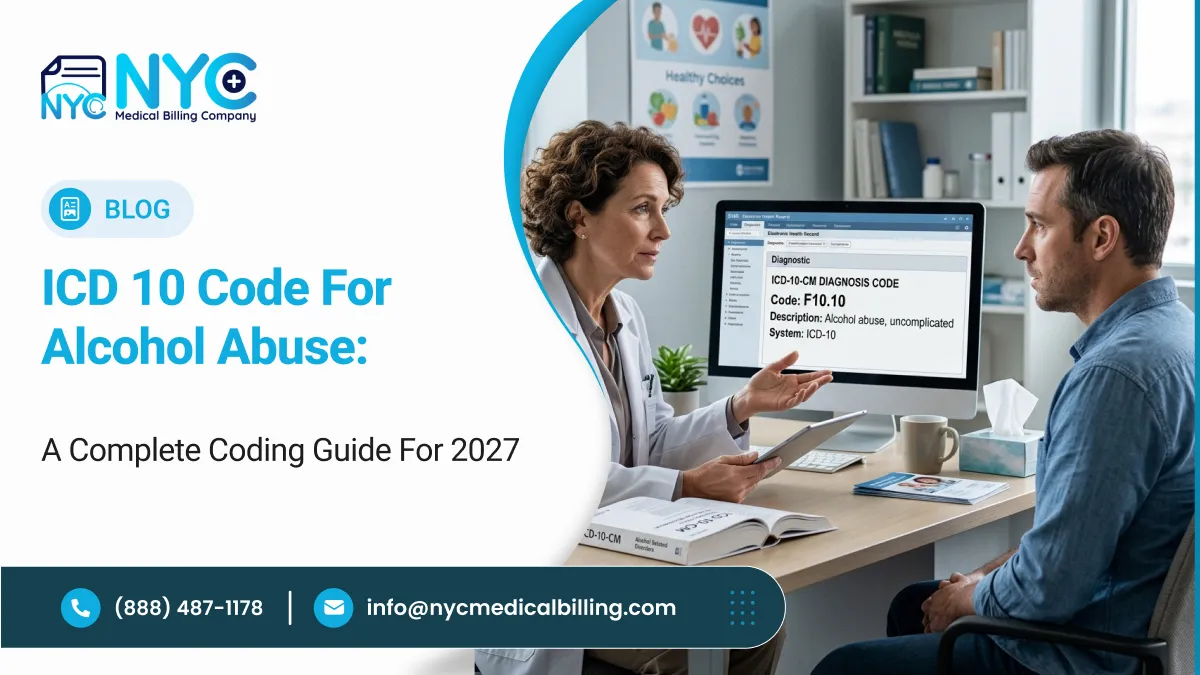
Alcohol abuse can look simple on a patient’s record. Picking the right diagnosis code is more than just noting a drinking history. The ICD‑10 code for alcohol abuse depends on what the provider writes as a diagnosis on any complications and on whether the patient has alcohol abuse or alcohol dependence.
For alcohol abuse doctors usually write F10.10. Still alcohol‑related intoxication, withdrawal, remission and other linked conditions need codes for alcohol abuse.
Wrong code choice can cause documentation errors claim processing and add more paperwork. This guide shows the FY2027 alcohol abuse ICD‑10‑CM codes what documentation is needed and the common billing mistakes that healthcare providers should avoid.
What Is the ICD 10 Code for Alcohol Abuse?
The ICD-10-CM code, for alcohol abuse is F10.10 – Alcohol abuse, uncomplicated.
Healthcare providers should use this code when the medical records clearly show alcohol abuse and there is no mention of any alcohol-related issue. These issues may include alcohol intoxication. These issues may include alcohol withdrawal. These issues may include any behavioral disorder that is caused by alcohol use.
The code F10.10 also covers alcohol use disorder as defined by the ICD-10-CM classification system. This means that when a patient has a form of alcohol use disorder and no further complications F10.10 is the correct code to use.
According to the Centers for Medicare & Medicaid Services (CMS), healthcare organizations must use the FY2027 ICD-10-CM code set for applicable services from October 1, 2026, through September 30, 2027.
Although F10.10 is often used for alcohol abuse doctors need to look at the full medical evaluation before using it. When the notes say there is an exact alcohol related problem a different code might be a better match, for the patient’s health issue.
Alcohol Abuse ICD-10-CM Codes for 2027
ICD-10-CM classifies alcohol-related disorders under category F10. Within this category, code selection depends on the documented pattern of alcohol use and any associated complications.
The following table outlines commonly reported alcohol abuse codes.
|
ICD-10-CM Code |
Official Description |
|---|---|
|
F10.10 |
Alcohol abuse, uncomplicated |
|
F10.11 |
Alcohol abuse, in remission |
|
F10.120 |
Alcohol abuse with intoxication, uncomplicated |
|
F10.121 |
Alcohol abuse with intoxication delirium |
|
F10.130 |
Alcohol abuse with withdrawal, uncomplicated |
|
F10.131 |
Alcohol abuse with withdrawal delirium |
|
F10.132 |
Alcohol abuse with withdrawal with perceptual disturbance |
|
F10.14 |
Alcohol abuse with alcohol-induced mood disorder |
|
F10.180 |
Alcohol abuse with alcohol-induced anxiety disorder |
|
F10.182 |
Alcohol abuse with alcohol-induced sleep disorder |
|
F10.19 |
Alcohol abuse with unspecified alcohol-induced disorder |
These codes help recognize medical situations. Doctors and people who handle coding should look at the diagnosis any papers that back it up the Alphabetic Index and the Tabular List, before finishing a claim.
For example a person getting help for alcohol abuse but not having any signs of being drunk or going through withdrawal might fit under F10.10. On the hand a person who has alcohol abuse and is going through withdrawal without any extra problems might need F10.130.
The difference is important because the diagnosis chosen has to show the condition that the doctor checked or took care of during the visit.
Understanding Alcohol Abuse vs. Alcohol Dependence ICD-10 Codes
Alcohol abuse and alcohol dependence belong to the same ICD-10-CM category, but they have different classifications. Providers should not use these terms interchangeably when assigning diagnosis codes.
Alcohol Abuse: F10.1
The F10.1- subcategory covers alcohol abuse and associated alcohol-induced conditions. It also classifies mild alcohol use disorder.
A provider may document problematic alcohol consumption that meets the clinical criteria for mild alcohol use disorder without establishing dependence.
For uncomplicated cases, F10.10 applies.
Alcohol Dependence: F10.2
The F10.2- subcategory covers alcohol dependence and the associated complications. It also classifies moderate or severe alcohol use disorder.
Some commonly reported codes include:
|
Code |
Diagnosis |
|---|---|
|
F10.20 |
Alcohol dependence, uncomplicated |
|
F10.21 |
Alcohol dependence, in remission |
|
F10.220 |
Alcohol dependence with intoxication, uncomplicated |
|
F10.230 |
Alcohol dependence with withdrawal, uncomplicated |
|
F10.231 |
Alcohol dependence with withdrawal delirium |
|
F10.24 |
Alcohol dependence with alcohol-induced mood disorder |
The provider’s diagnosis determines the appropriate code. Coders should not infer alcohol dependence solely from the quantity or frequency of alcohol consumption.
What if the provider documents both alcohol abuse and dependence?
The FY2027 ICD-10-CM Official Guidelines establish a clear hierarchy for psychoactive substance use, abuse, and dependence.
-
If the provider documents both alcohol use and abuse, assign the appropriate alcohol abuse code.
-
If the provider documents both abuse and dependence, assign the appropriate dependence code.
-
If the provider documents use, abuse and dependence together, assign the appropriate dependence code.
For the same substance, coders should apply this hierarchy rather than report separate codes for each documented level.
These requirements appear in Section I.C.5.b.2 of the FY2027 ICD-10-CM Official Guidelines for Coding and Reporting.
How to Code Alcohol Abuse With Intoxication
Alcohol intoxication may need a specific ICD-10-CM code if the physician notes alcohol abuse along with intoxication.
For instance F10.120 is used for alcohol abuse, with intoxication. If the provider confirms intoxication delirium linked to alcohol abuse then F10.121 is the correct code.
The medical record must focus on the clinical condition that has been diagnosed. It should not depend on past alcohol use or lab results. The documented diagnosis should reflect the patient’s health state.
Example: Alcohol Abuse With Intoxication
A patient comes into the emergency room after drinking alcohol. They have trouble walking and their speech is unclear. The doctor checks them. Says they have alcohol abuse with simple intoxication.
Correct code: F10.120 – Alcohol abuse with intoxication uncomplicated.
If the doctor writes only that the person has alcohol abuse and doesn’t say they are intoxicated the person coding the case should not just use F10.120 because of the persons symptoms or their blood alcohol level.
In the way coders should not assume someone has intoxication delirium just because they are confused. The actual diagnosis, from the doctor must back up the code that is chosen.
ICD 10 Code for Alcohol Abuse With Withdrawal
Alcohol withdrawal can happen when someone cuts back or quits drinking after an heavy period of alcohol use. The symptoms of Alcohol withdrawal differ from person to person detailed clinical records are essential.
Under the F10.1- subcategory, ICD-10-CM provides separate codes for alcohol abuse with withdrawal.
F10.130 – Alcohol Abuse With Withdrawal, Uncomplicated
This code applies when the physician establishes alcohol abuse with uncomplicated withdrawal.
The clinical record should support the diagnosis and identify the withdrawal condition.
F10.131 – Alcohol Abuse With Withdrawal Delirium
This code describes alcohol abuse with withdrawal delirium.
Providers should clearly document the diagnosis and any relevant findings supporting the assessment.
F10.132 – Alcohol Abuse With Withdrawal With Perceptual Disturbance
This code applies when the physician diagnoses alcohol abuse with withdrawal accompanied by perceptual disturbances.
Because hallucinations, delirium, and other manifestations may represent different clinical conditions, coding professionals should not select a complication code based on an isolated symptom.
When documentation identifies alcohol dependence instead of abuse, the appropriate code generally comes from F10.2-, not F10.1-.
ICD 10 Code for Alcohol Abuse in Remission
F10.11 – Alcohol abuse, in remission applies when the provider documents alcohol abuse in remission.
Remission coding requires clinical judgment. The medical record should establish that the alcohol-related disorder is in remission rather than simply describe a period without drinking.
For example, a patient may report avoiding alcohol for several months. However, that statement alone does not automatically establish a remission diagnosis.
The FY2027 guidelines distinguish remission coding by the severity of the substance use disorder:
-
Mild alcohol use disorder in remission maps to the appropriate alcohol abuse remission classification.
-
Moderate or severe alcohol use disorder in remission maps to the appropriate alcohol dependence remission classification.
Therefore, F10.11 and F10.21 are not interchangeable. Providers should document the current diagnosis and remission status clearly to support accurate reporting.
Documentation Requirements for Accurate Alcohol Abuse Coding
Accurate alcohol abuse coding begins with the physician’s assessment. A clear and detailed clinical record helps medical coders find the diagnosis. It also makes sure that clinical services match the claims that are submitted.
For practices that handle health visits documentation should cover these key areas.
1. Establish the Alcohol-Related Diagnosis
The provider must clearly state whether the patient has alcohol abuse, alcohol dependence or another confirmed alcohol‑related condition.
Remarks, like “drinks or “history of heavy drinking” do not automatically prove alcohol abuse.
If a provider writes that there is not information to confirm a diagnosis coding professionals should examine the record and ask for clarification when needed.
2. Record Any Associated Complications
If a patient shows signs of alcohol‑related intoxication, withdrawal or any other diagnosed complication the clinical record must clearly note that condition.
For example alcohol abuse that includes withdrawal needs a code, than alcohol abuse without withdrawal.
Doctors should also separate alcohol‑induced disorders from other independent mental health problems when the clinical evidence shows that difference.
3. Clarify the Current Condition and Remission Status
An old diagnosis does not automatically mean there is an alcohol‑related disorder.
The provider must check if the condition is still active if it is, in remission or if it is simply part of a history. Knowing this difference helps practices avoid reporting a disorder when the present evaluation does not support it.
4. Connect the Diagnosis to the Encounter
Medical records should explain how the alcohol-related condition affected the patient’s evaluation, treatment, counseling, monitoring, or medical decision-making.
For New York healthcare organizations managing complex behavioral health claims, NYC Medical Billing can support accurate diagnosis review, claim preparation, and medical billing workflows.
Common Alcohol Abuse ICD-10 Coding Mistakes
Even when the diagnosis appears straightforward, incomplete clinical documentation can create avoidable coding errors.
Using F10.10 for Every Alcohol-Related Encounter
F10.10 is not a code, for all alcohol-related conditions. It specifically stands for alcohol abuse.
If a provider documents dependence, intoxication, withdrawal or any other specific disorder the correct code must be used to reflect that diagnosis. Each condition has its code and using the right one ensures accurate medical records and proper care.
Confusing Alcohol Consumption With Alcohol Abuse
A patient can drink alcohol often. Still not meet the clinical criteria for alcohol use disorder.
Providers should set the diagnosis of just depending on how often the patient drinks how they answer screening questions or their social background.
In addition an unspecified alcohol use code labeled F10.9- needs a written connection, to a substance-related disorder or a medical condition. Must meet the relevant reporting rules.
Reporting Abuse and Dependence Separately
When the provider documents alcohol abuse. Also documents alcohol dependence assigning separate codes for alcohol abuse and alcohol dependence for the same substance conflicts, with the ICD-10-CM hierarchy.
Instead coders should choose the alcohol dependence code and account for any documented complications.
Assuming a Positive Alcohol Test Establishes a Disorder
A blood alcohol concentration result may support clinical assessment, but a laboratory value alone cannot establish alcohol abuse or dependence.
The FY2027 guidelines permit an additional code from category Y90 for documented blood alcohol levels when the patient’s provider has documented an F10-classifiable condition. The test result itself does not have to appear in the provider’s own documentation.
Coding an Unconfirmed Diagnosis as Established in Outpatient Care
Outpatient coding rules do not allow the reporting of diagnoses that are marked as probable, suspected, questionable or rule‑out conditions as if they were confirmed diagnoses.
Instead both providers and coders must report the degree of certainty that is supported by the encounter following the applicable outpatient guidelines.
Alcohol-Related Medical Conditions and ICD-10-CM Coding
Alcohol misuse often appears alongside conditions for example liver disorders, pancreatitis and problems, with nutrition.
Just because a diagnosis says “alcohol related” does not mean that alcohol caused every condition mentioned.
When a doctor writes down an alcohol‑related condition coders must look at the Alphabetic Index and the Tabular List to select the codes.
For example the official FY2027 guidelines say that alcohol-induced acute pancreatitis that comes with alcohol dependence needs the code from K85.2- and also an F10.2- code. Providers should not replace an alcohol-induced mental or behavioral disorder code with a code, for a medical condition that has its own specific classification.
Clinical Coding Example
A patient receives treatment, for acute pancreatitis. After a check the physician writes that this acute pancreatitis was caused by alcohol and that the patient has alcohol dependence but there is no separate note of an alcohol-related behavioral complication.
The coder should look at the K85.2 code and the F10.20 code applying all the Tabular List instructions. The final code selection and the sequencing of these codes must match the encounter documentation and the coding rules that apply.
How Alcohol Abuse ICD-10 Coding Affects Medical Billing
Accurate diagnosis coding helps healthcare organizations maintain consistent clinical records and prepare claims that reflect the services performed.
However, reporting the correct ICD-10-CM code does not automatically guarantee payment. Insurers may also evaluate medical necessity, covered benefits, provider eligibility, service documentation, authorization requirements and applicable billing policies.
Match Diagnosis Codes With Documented Services
For example, when a physician evaluates alcohol abuse during an outpatient encounter, the reported diagnosis should reflect the established condition.
The practice must separately determine the appropriate CPT or HCPCS procedure code based on the actual service performed.
Diagnosis codes identify medical conditions; procedure codes identify the services delivered.
Understand CPT and HCPCS Coding Considerations
Alcohol screening and behavioral counseling may involve codes such as:
|
Procedure Code |
General Purpose |
|---|---|
|
99408 |
Alcohol and/or substance abuse structured screening and brief intervention, 15–30 minutes |
|
99409 |
Alcohol and/or substance abuse structured screening and brief intervention, greater than 30 minutes |
|
G0442 |
Annual alcohol misuse screening, 15 minutes |
|
G0443 |
Brief face-to-face behavioral counseling for alcohol misuse, 15 minutes |
These procedure codes have distinct requirements. Providers should verify patient eligibility, documentation, service duration, payer coverage, and applicable coding rules before billing.
For instance, Medicare’s preventive alcohol screening and counseling benefits have specific coverage conditions. Practices should not automatically use G0443 for every patient with diagnosed alcohol abuse.
The diagnosis and procedure codes must independently meet the applicable requirements.
Review Medical Necessity and Payer Rules
A clinically accurate diagnosis code is only one element of a complete claim.
Healthcare providers should check whether the selected diagnosis supports the documented service under the relevant payer policy. They should also confirm that the record includes the required assessment, intervention, and treatment information.
A consistent medical coding review process can identify missing diagnoses, unsupported code combinations, and documentation gaps before submission.
Practical Alcohol Abuse ICD-10 Coding Examples
The following examples illustrate how the provider’s final assessment influences code selection.
|
Clinical Documentation |
Potential ICD-10-CM Code |
Coding Consideration |
|---|---|---|
|
Alcohol abuse without associated complication |
F10.10 |
Uncomplicated alcohol abuse |
|
Mild alcohol use disorder in remission |
F10.11 |
Provider documents remission |
|
Alcohol abuse with uncomplicated intoxication |
F10.120 |
Intoxication diagnosis established |
|
Alcohol abuse with uncomplicated withdrawal |
F10.130 |
Withdrawal diagnosis established |
|
Alcohol dependence without associated complication |
F10.20 |
Dependence takes precedence over abuse |
|
Alcohol dependence in remission |
F10.21 |
Remission status supported by the provider |
These examples provide general coding guidance. The complete medical record and current ICD-10-CM instructions determine the final code selection.
How Medical Billing Support Helps Reduce Alcohol-Related Claim Errors
Behavioral health practices, primary care clinics, hospitals, and specialty providers often handle encounters involving multiple diagnoses and treatment services.
Alcohol-related coding can become particularly challenging when the patient presents with other medical or psychiatric conditions.
Professional billing support can help practices identify documentation inconsistencies, review diagnosis and procedure code alignment and address payer-specific claim requirements.
NYC Medical Billing works with healthcare providers seeking more consistent medical billing, coding, and revenue cycle management processes. With organized claim reviews and documentation workflows, practices can reduce preventable coding corrections and spend less time resolving administrative issues.
Frequently Asked Questions About Alcohol Abuse ICD-10 Codes
What is the ICD 10 code for alcohol abuse?
F10.10 is the ICD-10-CM code for uncomplicated alcohol abuse. Providers use other F10 codes when the documentation establishes dependence or a specific alcohol-related complication.
Is F10.10 a billable ICD-10 code?
Yes. F10.10 is a valid, billable ICD-10-CM diagnosis code for FY2027. However, its billable status does not guarantee claim reimbursement.
What is the difference between F10.10 and F10.20?
F10.10 represents uncomplicated alcohol abuse, including mild alcohol use disorder. F10.20 represents uncomplicated alcohol dependence, including moderate or severe alcohol use disorder.
What is the ICD 10 code for alcohol abuse in remission?
F10.11 represents alcohol abuse in remission. Providers must document the remission status and coders must follow the classification guidelines for mild versus moderate or severe alcohol use disorder.
Can physicians report alcohol abuse and dependence together?
When both diagnoses refer to the same substance, ICD-10-CM directs coders to select the appropriate dependence code rather than separately reporting abuse and dependence codes.
Does alcohol abuse always require F10.10?
No. F10.10 applies to uncomplicated alcohol abuse. Documented conditions such as intoxication, withdrawal, remission, or alcohol-induced disorders may require more specific codes.
Final Thoughts
Choosing the correct ICD 10 code for alcohol abuse requires an accurate clinical diagnosis and documentation that reflects the patient’s condition. Although F10.10 identifies uncomplicated alcohol abuse, providers must distinguish abuse from dependence and consider any associated complications before finalizing the claim.
For FY2027, healthcare organizations should follow the current ICD-10-CM guidelines, review the complete encounter record, and confirm that diagnosis codes accurately support the reported services. These steps strengthen coding accuracy and help reduce avoidable claim corrections.