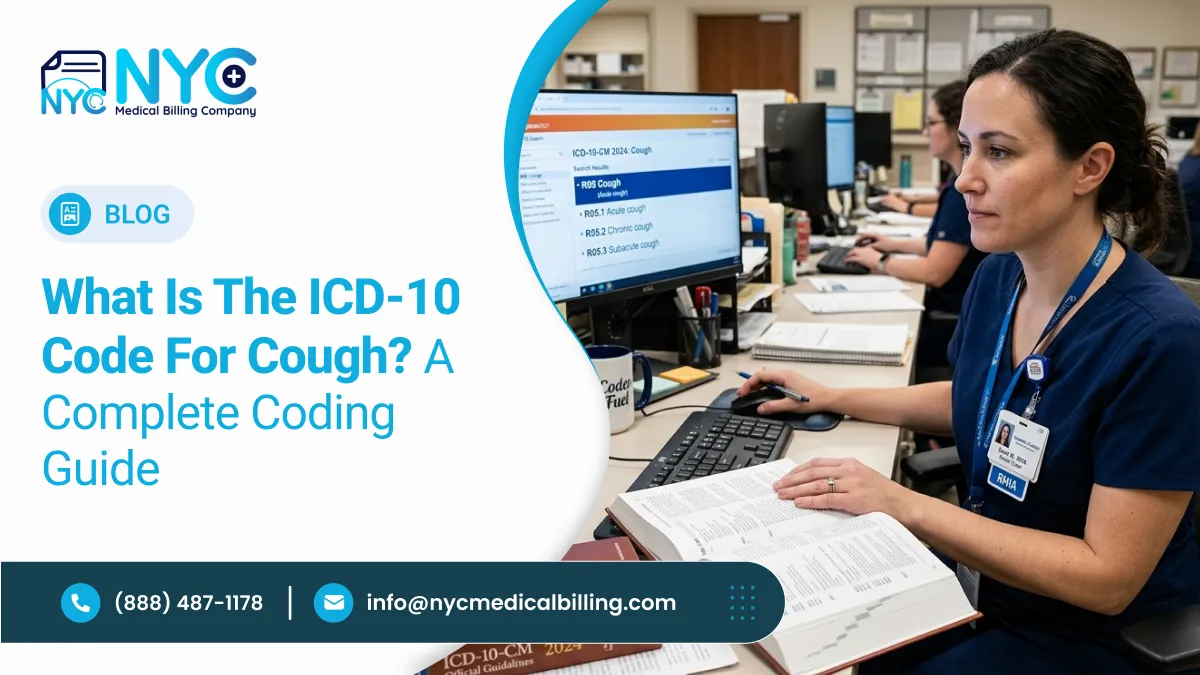
A cough can sound like one of the simplest symptoms to document. From a coding standpoint, however, “cough” alone may not provide enough detail to select the most accurate diagnosis code.
Was the cough acute, subacute, or chronic? Was the patient evaluated after nearly fainting during a severe coughing episode? Is a specific type of cough documented but not represented by one of the standard duration-based codes? Or has the provider simply documented “cough” without further description?
These distinctions matter because ICD-10-CM no longer relies on a single general R05 code for every cough encounter. The R05 category now contains multiple codes that allow providers to describe the patient’s condition more precisely.
For the FY 2027 ICD-10-CM code set the cough codes include R05.1, R05.2, R05.3, R05.4, R05.8 and R05.9.
This guide explains each ICD-10 code for cough this guide explains each ICD-10 code, for cough when symptom coding’s appropriate related respiratory diagnoses, documentation considerations, commonly associated procedures and mistakes that can create unnecessary claim problems.
What Is the ICD-10 Code for Cough?
The ICD-10-CM code, for cough is R05.-. This code is part of the section that deals with symptoms and signs related to the respiratory systems.
There is not one universal billable cough code for every patient. The appropriate code depends on how the cough is described in the medical record.
| ICD-10-CM Code | Description |
|---|---|
| R05.1 | Acute cough |
| R05.2 | Subacute cough |
| R05.3 | Chronic cough |
| R05.4 | Cough syncope |
| R05.8 | Other specified cough |
| R05.9 | Cough, unspecified |
CMSs FY 2027 respiratory diagnosis information still includes these six codes within the R05 family.
The key point for providers is straightforward: pick the code that matches what was actually found and documented during the patient’s visit. Don’t just default to R05.9. Always use the specific code that reflects the actual diagnosis.
R05.1 – Acute Cough
R05.1 is used when the provider specifically documents an acute cough.
An intense cough is often seen when someone has a short-term breathing problem or when their airways are irritated for a while. Based on how the patient’s doing it can happen with conditions, like:
- viral upper respiratory infections
- acute bronchitis
- influenza
- COVID-19
- allergic or environmental irritation
- pneumonia
- acute sinus or nasal conditions
The presence of a cough does not mean that R05.1 can always be used as the main diagnosis.
If the doctor finds a cause for the cough the coding should match the actual diagnosis documented. This follows the rules set by ICD-10-CM.
For example imagine a patient comes in with a cough and fever. After tests and a physical exam the physician says it’s pneumonia. In this case pneumonia is the diagnosis to code. It gives useful information than just coding acute cough.
But if no clear diagnosis is found and the main reason, for the visit is still the cough then R05.1 can be used appropriately. It shows the condition being looked at.
Documentation example
Patient presents with acute nonproductive cough beginning four days ago. No confirmed bacterial respiratory infection identified.
In this situation, R05.1 is supported because the provider specifically identifies the cough as acute.
R05.2 – Subacute Cough
R05.2 represents a subacute cough.
This code helps to classify a cough that’s not quite acute but also not fully chronic. It’s useful when symptoms go on for longer, than the short-term illness but the doctor doesn’t see it as a long-term condition yet.
A subacute cough may follow:
- a recently resolved respiratory infection
- airway irritation
- bronchial inflammation
- postinfectious respiratory symptoms
- upper airway conditions
- other temporary pulmonary or respiratory problems
Providers need to write down what the cough is like, from a point of view. They should not depend on billing staff to guess if the cough is new lasting a few weeks or has been going on for a time.
Documentation example
Persistent cough following recent viral respiratory illness; currently assessed as subacute cough.
The appropriate symptom code would be R05.2.
R05.3 – Chronic Cough
R05.3 is the ICD-10-CM code for chronic cough.
This code can also be useful when the records show a long‑lasting mysterious chronic cough rather than a short respiratory issue.
A chronic cough often needs a test because many different conditions can cause a continuing chronic cough, such, as:
- asthma
- gastroesophageal reflux disease
- chronic bronchitis
- upper airway conditions
- postnasal drainage
- medication-related cough
- environmental exposure
- chronic pulmonary disease
- interstitial lung disease
- other respiratory disorders
Providers should avoid using R05.3 simply because a patient has coughed times before. The medical record must show that the patient’s current complaint is chronic.
When the evaluation finds the root cause the confirmed condition may need to be coded of or sometimes alongside the symptom, depending on coding rules and clinical circumstances.
Documentation example
Patient evaluated for chronic dry cough continuing despite resolution of previous upper respiratory infection. Etiology remains under evaluation.
If no definitive diagnosis has been established, R05.3 can accurately communicate the condition being investigated.
R05.4 – Cough Syncope
R05.4 describes cough syncope.
Cough syncope means fainting or loss of consciousness that happens when someone coughs hard. This is a specific problem, not just a normal cough. Cough syncope should only be used when the doctor’s notes clearly show this condition.
Always read the ICD‑10‑CM tabular instructions, for cough syncope. The order of the instructions can change how the claim is coded.
If a patient says they feel dizzy while coughing but never actually fainted and the doctor does not diagnose cough syncope then R05.4 should not be used.
The diagnosis needs to come from the clinical documentation.
R05.8 – Other Specified Cough
R05.8 means other specified cough.
This code can be helpful when the provider notes a type or feature of cough but that condition does not match the more precise categories like acute subacute, chronic or cough-syncope.
The difference between R05.8 and R05.9 matters a lot.
R05.8 means the cough has been clearly described. The provider gave a detail. R05.9 means there is no extra information available, about the cough.
Providers should therefore make sure the note explains the cough characteristic that supports choosing the “other specified” category.
R05.9 – Cough, Unspecified
R05.9 is the ICD-10-CM code for cough, unspecified.
This is generally appropriate when the patient has a cough but the documentation does not identify it as:
- acute
- subacute
- chronic
- cough syncope
- another specified type
For example:
Chief complaint: cough. Duration and type not clearly established.
If no new diagnostic information appears during the visit R05.9 might be suitable.
However R05.9 must not become a fix when the chart already contains R05.1, R05.2, R05.3, R05.4 or R05.8.
The latest ICD‑10‑CM rules ask coders to record the detailed diagnosis that the chart can justify.
Is R05 Still a Billable ICD-10 Code?
Providers may still see R05 referenced as the general category for cough, but the category has been divided into more specific codes.
For current claims, practices should identify the appropriate code within the R05 family rather than treating R05 as the final diagnosis code.
The current choices are:
R05.1 — Acute cough
R05.2 — Subacute cough
R05.3 — Chronic cough
R05.4 — Cough syncope
R05.8 — Other specified cough
R05.9 — Cough, unspecified
The greater specificity gives payers and other clinicians more useful information about why the patient was evaluated.
When Can a Cough Be Coded as a Symptom?
A common coding question is whether a symptom such as cough can be reported when the physician has not yet determined its cause.
Yes.
In outpatient encounters the ICD-10-CM guidelines permit coding of the condition, problem, symptom, sign or other reason for the visit when a definitive diagnosis has not yet been established.
When you go to an outpatient encounter you may not have a diagnosis yet. The ICD-10-CM guidelines say it is acceptable to code the condition, problem, symptom, sign or the reason for the visit.
The FY 2027 guidelines state that outpatient diagnoses written as probable suspected, questionable rule out compatible with consistent with or similar uncertain terms should not be coded as if they were confirmed.
So if the doctor writes “probable” or “suspected ” you should not treat that as a diagnosis. Instead the encounter, in an outpatient setting should be coded using the degree of certainty, which may involve the patient’s signs and symptoms.
Consider this example:
A patient comes in with coughing, wheezing and shortness of breath. The physician thinks it might be asthma. Hasn’t confirmed it yet.
For an outpatient claim the practice should not just assume asthma is the diagnosis. The symptoms alone—coughing, wheezing and shortness of breath—should be coded as the diagnoses, for this visit.
After a clear diagnosis of asthma is confirmed should the coding change to reflect that condition. Always follow the coding guidelines when making these decisions.
Related ICD-10 Codes That May Appear With a Cough
Cough rarely exists in isolation. Depending on the clinical presentation, providers may document other respiratory signs or symptoms.
Common related codes include:
| Condition | ICD-10-CM Code |
|---|---|
| Shortness of breath | R06.02 |
| Wheezing | R06.2 |
| Dyspnea, unspecified | R06.00 |
| Acute respiratory distress | R06.03 |
| Other forms of dyspnea | R06.09 |
| Stridor | R06.1 |
| Tachypnea, NEC | R06.82 |
| Hemoptysis | R04.2 |
| Abnormal sputum | R09.3 |
CMS continues to list many of these conditions within respiratory signs and symptoms.
These codes should not be added automatically just because a patient has a cough. Every extra diagnosis must have support in the medical record. Each one also needs to meet the rules for reporting.
Cough With Blood Is Different From an Ordinary Cough
A particularly important distinction involves a patient who is coughing up blood.
This clinical finding may denotes hemoptysis, which is coded differently from an ordinary cough.
The relevant ICD-10-CM code is:
R04.2 — Hemoptysis
Physicians should describe the clinical finding clearly rather than documenting only “severe cough” when blood is actually present.
Accurate terminology helps prevent the encounter from being represented by a less appropriate cough code.
Do Not Confuse Smoker’s Cough With R05.9
Another important coding distinction involves smoker’s cough.
The ICD-10-CM classification has long directed a smokers cough to the code J41.0, which stands for chronic bronchitis instead of grouping it under the general code R05 for cough. The cough category also separates hemoptysis from a cough.
This shows why it is important to consult the ICD-10-CM index and table instructions when the documentation includes more, than the word “cough.”
Cough and COVID-19 Coding
A patient might show signs like coughing, fever, trouble breathing, tiredness or other things that could point to COVID-19.
The way to code this depends on whether COVID-19’s actually proven.
If the infection is confirmed then the coding should follow the rules for COVID-19.
If there is no diagnosis then the code should be based on what is known about the symptoms during that visit.
Earlier guidance from CMS gives examples of this. It says to use R05.1 for a cough or R05.9 for a cough that is not clear when a patient has symptoms linked to COVID-19. No confirmed case.
The main idea applies to more, than COVID-19. Do not change a guess into a diagnosis just to make a claim look more detailed.
Common Conditions That May Cause Cough
Cough is a symptom and not a disease, on its own. Looking at the patients history. Doing a physical exam can help find what is causing the cough. The cause can be linked to different parts of the body.
Some commonly evaluated causes include:
Upper respiratory infections
Viral respiratory infections frequently cause temporary coughing along with nasal symptoms, sore throat, congestion, or fever.
Bronchitis
Inflammation involving the bronchial tubes may produce coughing, mucus production, chest discomfort and wheezing.
Pneumonia
Patients with pneumonia might present with cough, fever, shortness of breath, chest pain, or abnormal lung findings.
Asthma
Cough may sometimes be a prominent asthma symptom, especially when accompanied by wheezing, airway limitation, or respiratory triggers.
Gastroesophageal reflux
Reflux may contribute to persistent or recurrent coughing in some patients, particularly when pulmonary evaluation does not identify an obvious explanation.
Upper airway conditions
Postnasal drainage and nasal or sinus disorders may contribute to recurrent coughing.
Medication-related cough
Certain medications can produce persistent cough as an adverse effect. The provider’s assessment can establish the connection before coding a drug-related condition.
Chronic pulmonary disease
COPD, chronic bronchitis, interstitial lung disorders, and other pulmonary diseases can also present with coughing.
The presence of a cough should therefore lead to accurate clinical assessment rather than automatic reliance on a symptom code when a definitive diagnosis is already known.
CPT Codes Commonly Associated With a Cough Evaluation
There is no CPT code specifically for “treating a cough.” CPT codes identify the professional service, test, or procedure performed rather than the symptom itself.
Depending on medical necessity and the services actually provided, a cough evaluation may involve:
| Service | Common CPT Code |
|---|---|
| New patient office/outpatient E/M | 99202–99205 |
| Established patient office/outpatient E/M | 99211–99215 |
| Chest radiography, 2 views | 71046 |
| Spirometry | 94010 |
| Spirometry with bronchodilator responsiveness testing | 94060 |
| Pulse oximetry, single determination | 94760 |
These codes should never be treated as a preset “cough billing package.”
The appropriate CPT code depends on the actual service provided, documentation, medical necessity, payer rules, and current CPT instructions.
For example, a patient with an uncomplicated acute cough may require only an office evaluation, while someone with persistent coughing, shortness of breath, or suspected pulmonary disease may undergo additional diagnostic testing.
CMS coverage information also demonstrates that cough diagnoses can support certain respiratory testing in appropriate circumstances, but coverage remains dependent on the individual service and applicable policy.
Documentation That Supports Accurate Cough Coding
A good respiratory note does not need to be unnecessarily long. It needs to capture the details that actually affect diagnosis and treatment.
For cough encounters, useful documentation may include:
Onset and duration: When did the cough begin?
Clinical characterization: Is it acute, subacute, chronic, productive, dry, persistent, or otherwise clinically described?
Associated symptoms: Is the patient experiencing fever, shortness of breath, wheezing, chest discomfort, sputum, or hemoptysis?
Relevant history: Is there asthma, COPD, smoking history, recent respiratory infection, medication exposure, or reflux?
Evaluation performed: Were lung findings documented? Was imaging or pulmonary testing performed?
Assessment: Has an underlying diagnosis been established, or does the encounter remain symptom-based?
Plan: What treatment, testing, monitoring, referral, or follow-up was recommended?
This clinical detail improves continuity of care while also giving the claim enough information to support the diagnosis reported.
Why Unspecified Cough Codes Can Become a Billing Problem
Using R05.9 is not inherently incorrect.
There are legitimate encounters where the documentation simply supports “cough” and nothing more specific has been established.
Problems arise when R05.9 is submitted even though the record clearly identifies an acute, subacute, chronic, or otherwise specified cough.
That mismatch may create questions about coding accuracy, medical necessity, or the relationship between the diagnosis and the service performed.
For practices dealing with recurring diagnosis-to-procedure mismatches or respiratory claims that require repeated correction, NYC Medical Billing can help providers review coding, claim submission, denial trends, and documentation-related revenue cycle issues without replacing the physician’s clinical judgment.
Common Cough Coding Mistakes
Coding every cough as R05.9
Unspecified coding should be used when the documentation is genuinely unspecified—not simply because it is quicker.
Guessing whether a cough is acute or chronic
The medical record should support the classification. Coders should not independently convert an undocumented duration into a clinical diagnosis.
Reporting only the symptom when a definitive diagnosis has been established
When the physician identifies the underlying condition, providers should review whether the symptom should still be separately reported under ICD-10-CM rules.
Coding a suspected outpatient diagnosis as confirmed
Outpatient coding guidelines require conditions documented as probable, suspected, rule out, or similar uncertain terms to be coded to the highest level of certainty available rather than reported as established diagnoses.
Confusing hemoptysis with ordinary cough
Coughing up blood is not simply an “other cough.” The documentation should reflect hemoptysis when clinically appropriate.
Choosing a diagnosis simply to obtain coverage
Diagnosis selection must reflect the patient’s actual documented condition. A code should never be changed merely because another diagnosis appears more likely to satisfy a payer’s policy.
How Cough-Related Claims Can Be Denied
A valid cough code does not automatically guarantee payment.
Claims may encounter problems when:
- the diagnosis does not support the medical necessity of the procedure
- an unspecified diagnosis is used despite more detailed documentation
- the CPT code is inconsistent with the documented service
- required information is missing from the claim
- a payer’s coverage criteria are not met
- documentation does not adequately support the level of service
- the patient’s eligibility or benefits were not verified
- authorization requirements were missed
- the claim contains coding or demographic errors
Practices should investigate the actual denial reason rather than repeatedly correcting and resubmitting a claim without identifying why it was rejected.
Improving Accuracy Before a Claim Is Submitted
Preventing errors before submission is usually more efficient than correcting a denied claim later.
Providers can improve cough-related claim accuracy by documenting the nature of the cough clearly, connecting diagnostic testing to the clinical reason it was ordered, using specific diagnosis codes when supported, and avoiding unconfirmed diagnoses in outpatient coding.
A structured review of recurring denials can also reveal whether the underlying problem is coding specificity, documentation, eligibility, payer policy, or claim configuration.
For practices that want support beyond individual claims, NYC Medical Billing can assist with medical coding review, claims processing, denial management, A/R follow-up, payment posting, and other revenue cycle functions while keeping documentation and code selection aligned with the provider’s recorded services.
Final Takeaway
There is no single ICD-10 code that should automatically be assigned to every patient who presents with a cough.
The R05.- cough family gives providers several choices:
- R05.1 for acute cough
- R05.2 for subacute cough
- R05.3 for chronic cough
- R05.4 for cough syncope
- R05.8 for other specified cough
- R05.9 for unspecified cough
The most accurate code is the one supported by the patient’s clinical documentation.
When the underlying cause has not been established in an outpatient setting, symptom coding is often appropriate. When a definitive diagnosis is confirmed, coding should move beyond the symptom when required by the applicable guidelines.
Frequently Asked Questions About the ICD-10 Code for Cough
What is the ICD-10 code for cough?
Cough is classified under the R05.- category. The exact code depends on whether the cough is acute, subacute, chronic, associated with cough syncope, otherwise specified, or unspecified.
What is the ICD-10 code for an unspecified cough?
The ICD-10-CM code for an unspecified cough is R05.9.
What is the ICD-10 code for acute cough?
The code for acute cough is R05.1.
What is the ICD-10 code for subacute cough?
The code for subacute cough is R05.2.
What is the ICD-10 code for chronic cough?
The code for chronic cough is R05.3.
What is the ICD-10 code for cough syncope?
The code for cough syncope is R05.4. Providers should also review the applicable ICD-10-CM tabular instructions when coding the encounter.
What does R05.8 mean?
R05.8 represents other specified cough and may be appropriate when the provider documents a particular cough that does not fall into the acute, subacute, chronic, or cough-syncope categories.
Can R05.9 be used when the cause of a cough is unknown?
Yes. If no definitive diagnosis is established and the documentation identifies only an unspecified cough, R05.9 can be appropriate. If the provider documents a more specific type of cough, the corresponding specific code should be considered.
Can cough be coded along with shortness of breath?
Potentially, yes. If both symptoms are documented, clinically relevant, and no established diagnosis explains or incorporates them in a way that prevents separate reporting, the applicable codes may be reported according to ICD-10-CM guidelines.