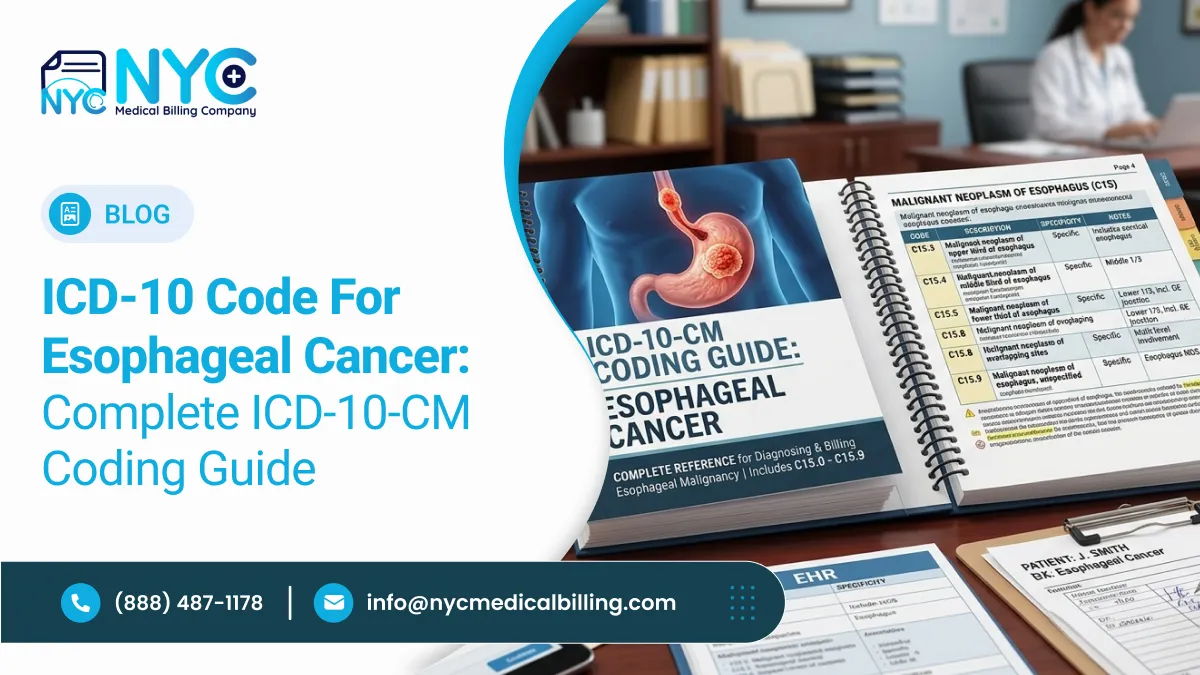
Coding for esophageal cancer seems uncomplicated at first glance: find the malignancy, assign a diagnosis code and submit the claim. In practice, the ICD-10 Code for Esophageal Cancer is very dependent on the location of the tumor, the specificity of the site recorded by the physician, whether the malignancy is active or historical, and the presence of metastatic illness.
Those details matter beyond the diagnosis coding. – A generic or unsubstantiated diagnosis may impact the medical necessity of endoscopy, pathology, imaging, chemotherapy, radiation treatment, surgery and follow-up services. The result may result in denials, delayed payment, undercoding, overcoding, inaccurate reimbursement or undue audit exposure.
This guide includes the C15 ICD‑10‑CM family, site-specific codes for cancer, secondary malignancy and related encounters, documentation rules for esophageal cancer, CPT codes that are most common in esophageal cancer billing, sequence of writing codes for esophageal cancer, and practical steps for billing when you process esophageal cancer claims.
What Is the ICD-10 Code for Esophageal Cancer?
The ICD-10-CM category for neoplasm of the esophagus is C15. When a doctor writes cancer and does not say where and the cancer is, in the esophagus the category C15.9, Malignant neoplasm of esophagus unspecified might be the right choice.
However C15.9 should not automatically be used for every patient, with cancer. The C15 category has specific codes that depend on where the main cancer is located. These codes cover the part, the thoracic part, the abdominal part and the upper-third middle-third and lower-third parts of the esophagus.
For example:
C15.3 identifies a malignant neoplasm of the upper third of the esophagus.
C15.4 identifies a malignant neoplasm of the middle third.
C15.5 identifies a malignant neoplasm of the lower third.
C15.8 applies to an overlapping lesion when the appropriate requirements for an overlapping primary site are met.
C15.9 represents an unspecified esophageal site.
The key billing principle is simple: code to the level of specificity that the providers documentation supports, rather, than automatically defaulting to C15.9.
Which ICD-10-CM Version Applies in 2026?
Date of service matters because ICD-10-CM operates on the federal fiscal-year cycle.
For services provided October 1, 2025 through September 30, 2026, the applicable FY 2026 ICD-10-CM code set should be used. For services provided October 1, 2026 through September 30, 2027, the FY 2027 ICD-10-CM release applies. CDC confirms that the October 1, 2026 release replaces the prior FY 2026 release for services beginning on that date.
This difference matters a lot when claims are filed corrected or appealed after a new code set becomes effective. The coding team must not simply use the code set that’s current, on the day the claim is being processed. The code set that is used must match the date‑of‑service rules that’re relevant.
For CPT and HCPCS reporting, verify the edition and code files applicable to the calendar-year date of service. CMS also updates NCCI policies and edits separately. The current Medicare NCCI Policy Manual is effective January 1, 2026.
ICD-10 Code for Esophageal Cancer: Master Reference Table
| Condition or documented site | ICD-10-CM code | Description |
|---|---|---|
| Cervical esophageal cancer | C15.0 | Malignant neoplasm of cervical part of esophagus |
| Thoracic esophageal cancer | C15.1 | Malignant neoplasm of thoracic part of esophagus |
| Abdominal esophageal cancer | C15.2 | Malignant neoplasm of abdominal part of esophagus |
| Upper-third esophageal cancer | C15.3 | Malignant neoplasm of upper third of esophagus |
| Middle-third esophageal cancer | C15.4 | Malignant neoplasm of middle third of esophagus |
| Lower-third esophageal cancer | C15.5 | Malignant neoplasm of lower third of esophagus |
| Overlapping esophageal lesion | C15.8 | Malignant neoplasm of overlapping sites of esophagus |
| Site not specified | C15.9 | Malignant neoplasm of esophagus, unspecified |
| Carcinoma in situ | D00.1 | Carcinoma in situ of esophagus |
| Personal history of esophageal malignancy | Z85.01 | Personal history of malignant neoplasm of esophagus |
| Chemotherapy encounter | Z51.11 | Encounter for antineoplastic chemotherapy |
| Immunotherapy encounter | Z51.12 | Encounter for antineoplastic immunotherapy |
| Radiation encounter | Z51.0 | Encounter for antineoplastic radiation therapy |
| Follow-up after completed cancer treatment | Z08 | Follow-up examination after completed treatment for malignant neoplasm |
The C15 codes are used to describe the site of the cancer not its histologic type or stage. So a diagnosis like cell carcinoma or adenocarcinoma, on its own does not decide which C15 code should be used. The documented primary site is still the important factor.
Likewise, cancer stage is clinically important but does not replace anatomical ICD-10-CM site selection. The National Cancer Institute says that the stage of cancer is very important when planning treatment. Treatment can involve surgery or medicine like chemotherapy. It can also include radiation or a mix of radiation and chemotherapy. Other options might be procedures or treatments that target specific parts of the cancer. The right choice depends on what’s best, for each patient.
How to Select the Correct Esophageal Cancer ICD-10 Code
1. Start With the Provider’s Diagnosis
Begin with the diagnosis documented by the responsible provider.
Do not assign a malignancy just because an imaging study shows a suspicious mass or because an endoscopy finds an abnormal lesion. Coders should not take findings and turn them into a cancer diagnosis on their own.
NCI describes upper endoscopy/esophagoscopy and biopsy as important procedures in diagnosing esophageal cancer; biopsy allows tissue to be examined for evidence of malignancy.
If cancer has not yet been established and the encounter is for evaluation of symptoms or an abnormal finding, the appropriate diagnosis may instead be the documented symptom, sign, or abnormal finding, subject to the applicable coding guidelines.
2. Determine the Exact Primary Site
Once active esophageal cancer is documented, determine whether the record specifies:
- cervical esophagus;
- thoracic esophagus;
- abdominal esophagus;
- upper third;
- middle third;
- lower third;
- overlapping sites; or
- an unspecified esophageal location.
The difference between C15.3 and C15.5 is not just in the way they look. These codes tell us about places where the primary tumor is located. This information can help doctors understand the patients condition better. It can also support decisions, about treatment, staging, procedures and reviews by insurance payers.
3. Do Not Confuse Histology With Location
Two commonly encountered histologic types of esophageal malignancy are adenocarcinoma and squamous cell carcinoma.
ICD-10-CM C15.- selection, however, is primarily based on the documented anatomical location of the primary esophageal malignancy. Histology may be important for oncology treatment and pathology reporting, but it should not be used to invent an anatomical location that the provider has not documented.
For example, a pathology report showing adenocarcinoma does not automatically justify C15.5. If the site remains unclear, additional documentation may be required.
4. Use C15.8 Carefully for Overlapping Lesions
C15.8 should not be selected merely because a large tumor extends across more than one part of the esophagus.
The overlapping-lesion concept applies when a single lesion overlaps contiguous sites and its point of origin cannot be determined according to ICD-10-CM rules. If the primary origin is documented, the code for that established site may be more appropriate.
This distinction can prevent inappropriate use of C15.8 for every extensive esophageal tumor.
5. Use C15.9 Only When the Site Is Truly Unspecified
C15.9 is a valid billable diagnosis when documentation supports esophageal malignancy but does not identify the anatomical portion.
It should not become a shortcut when more specific documentation is available elsewhere in the record.
For example:
Documentation: “Biopsy-confirmed adenocarcinoma of the lower third of the esophagus.”
Appropriate site code: C15.5
Using C15.9 in this situation would lose documented specificity.
6. Identify Metastatic Disease Separately
Esophageal cancer can spread beyond its primary site. When secondary malignant disease is documented, additional ICD-10-CM codes may be necessary to identify the metastatic location.
Examples of categories that may become relevant include:
| Metastatic disease | ICD-10-CM category/example |
|---|---|
| Secondary lymph-node malignancy | C77.- |
| Secondary lung malignancy | C78.0- |
| Secondary liver malignancy | C78.7 |
| Other secondary digestive-organ malignancy | C78.- |
| Secondary bone malignancy | C79.51 |
| Other secondary-site disease | Appropriate C77-C79 code |
Do not assume metastasis from staging terminology, imaging findings, or suspicious lesions without sufficient diagnostic documentation.
Primary and secondary cancer sites should also never be confused. A patient with primary esophageal cancer metastatic to the liver does not have primary liver cancer. The esophageal primary and documented liver metastasis are coded according to their respective primary and secondary malignancy categories.
7. Determine Whether the Cancer Is Active or Historical
This is one of the most important decisions in oncology coding.
An active C15.- diagnosis should not automatically remain on claims forever simply because the patient once had esophageal cancer.
When the primary malignancy has been completely treated and no further treatment is directed at that site, the Official Guidelines should be reviewed to determine whether a personal-history code is appropriate. Z85.01 identifies a personal history of malignant neoplasm of the esophagus.
For surveillance after completed cancer treatment, Z08 may also become relevant. FY 2027 ICD-10-CM guidance confirms that Z08 may be assigned for follow-up after completed treatment for malignant neoplasm.
The treatment status documented for the individual patient should drive this decision.
8. Apply Encounter Sequencing Rules
Cancer-related encounters do not always place the malignancy code first.
For example when a visit is for antineoplastic chemotherapy, radiation therapy or immunotherapy the right encounter code might have certain rules, about how it should be listed. These rules come from the ICD-10-CM Official Guidelines.
Common codes include:
Z51.11 – encounter for antineoplastic chemotherapy
Z51.12 – encounter for antineoplastic immunotherapy
Z51.0 – encounter for antineoplastic radiation therapy
The active malignancy is then additionally reported as appropriate.
Sequencing becomes more complicated when the patient is admitted for complications, treatment-related conditions, anemia, dehydration, pain, metastatic disease, or another reason. Always apply the guideline relevant to the actual reason for the encounter.
Documentation Requirements for Esophageal Cancer Coding
Specific diagnosis coding starts with specific clinical documentation. A coder cannot reliably distinguish C15.3, C15.4, C15.5, and C15.9 when the record says only “esophageal CA.”
Better documentation also helps connect the diagnosis to procedures and treatments when payers evaluate medical necessity.
| Documentation element | Why it matters |
|---|---|
| Confirmed diagnosis | Distinguishes established cancer from suspected disease or abnormal findings |
| Exact primary tumor location | Supports the correct C15.- code |
| Histologic diagnosis when known | Supports the clinical oncology record and treatment planning |
| Active versus previously treated cancer | Helps distinguish C15.- from history/follow-up coding |
| Metastatic sites | Supports additional C77-C79 coding where appropriate |
| Treatment status | Helps establish active treatment versus surveillance |
| Reason for current encounter | Affects diagnosis sequencing |
| Symptoms being evaluated or treated | May support additional diagnosis reporting when appropriate |
| Procedure performed | Must correspond to the CPT/HCPCS claim |
| Pathology findings | Support diagnostic confirmation and oncology planning |
| Treatment plan | Supports chemotherapy, immunotherapy, radiation, surgery, or other services |
| Relevant complications | May require separate coding and affect sequencing |
Documentation should reflect what is clinically known at the time of the encounter rather than being expanded solely to obtain reimbursement.
CPT Codes Commonly Associated With Esophageal Cancer
There is no single “esophageal cancer CPT code.” ICD-10-CM reports the diagnosis, while CPT/HCPCS codes describe the services performed.
The correct CPT code therefore depends on whether the provider is diagnosing, staging, treating, monitoring, or providing supportive care.
Endoscopy, Biopsy, and Staging
| Service | Common CPT code | Billing use |
|---|---|---|
| Diagnostic upper GI endoscopy | 43235 | Diagnostic EGD |
| Upper GI endoscopy with biopsy | 43239 | Tissue biopsy during EGD |
| Upper GI endoscopy with ultrasound | 43237 | EUS evaluation when performed |
| EUS-guided needle aspiration/biopsy | 43242 | EUS-guided tissue acquisition |
| Endoscopic dilation | 43248/43249 | Selected dilation techniques when medically necessary |
| Upper GI endoscopy with stent placement | 43266 | Endoscopic stent placement when applicable |
| Surgical pathology | 88305 | Common tissue pathology examination code |
CMS data confirm use of 43235 for diagnostic upper GI endoscopy, 43239 for endoscopic biopsy, and 43242 for ultrasound-guided needle aspiration/biopsy of the upper GI tract.
An article about Medicare coverage also lists C15.3, C15.4, C15.5, C15.8 and C15.9 as diagnoses that might support necessity for specific upper-GI endoscopy services under that contractors policy. The coverage depends on the contractor and the payer. So this should not be seen as an approval, for every procedure.
Imaging and Staging Services
Depending on clinical circumstances, esophageal cancer evaluation and staging may involve CT, PET/CT, or other imaging.
Examples of commonly encountered codes include:
71260 – CT chest with contrast
74177 – CT abdomen and pelvis with contrast
78815 – PET/CT imaging from skull base to mid-thigh
The imaging code must match what was actually ordered and performed. I think we should check necessity, contrast use, imaging protocol, authorization requirements and payer-specific rules instead of just picking an imaging code because the patient has cancer.
Esophageal Surgery
Esophagectomy coding is particularly dependent on the operative technique and extent of resection.
Potential CPT families include codes such as:
43107, 43108, 43112, 43113, 43116, 43117, 43118, 43121-43124
CMS code files identify these as procedures involving complete or partial removal of the esophagus.
Do not select among these codes from the diagnosis alone. The operative report must be reviewed for the surgical approach, extent of esophageal resection, reconstruction, and other required CPT distinctions.
Chemotherapy and Immunotherapy Administration
Common administration codes used in oncology include CPT codes, from the 96401-96549 group. These codes vary depending on the drug being used the way it is given how long the treatment. The type of service provided. For example code 96413 might be used for initial intravenous chemotherapy infusion services.
Drug billing requires an additional layer of verification. The correct HCPCS J-code or other drug code depends on the specific agent, dose, billing unit, payer, date of service, and applicable HCPCS release.
Do not choose a drug code simply from the cancer diagnosis.
Radiation Oncology
Esophageal cancer may also involve radiation therapy or chemoradiation. NCI recognizes radiation and combined chemoradiation among treatment approaches used for esophageal cancer.
Depending on the service performed, radiation oncology claims can involve codes for treatment planning, dosimetry, delivery, and management, including codes such as 77301 for certain IMRT planning services and 77427 for radiation treatment management.
CMS NCCI guidance contains bundling rules affecting radiation oncology services. For example, it explains that certain planning and physics services cannot routinely be reported together and that brachytherapy services incorporate specified management services in particular circumstances.
For that reason, radiation claims should be coded from the documented services and checked against current NCCI edits rather than assembled from a generic cancer code list.
Common Diagnosis Codes That May Appear With Esophageal Cancer Claims
Cancer claims often contain more than the primary C15.- diagnosis.
Depending on what the provider documents and what is being treated, additional diagnoses may include symptoms or complications such as dysphagia, weight loss, nutritional problems, pain, anemia, or treatment-related conditions.
For example, the R13.- family includes dysphagia diagnoses. However, additional symptom coding should follow the applicable ICD-10-CM guidelines. Symptoms should not be added simply to increase the number of diagnoses on a claim.
The relationship between the cancer, its treatment, and any complication must also be documented when required by ICD-10-CM conventions.
Practical Esophageal Cancer Billing Workflow
1. Verify the Diagnosis
Confirm whether the record documents active malignancy, suspected disease, carcinoma in situ, personal history, or follow-up after completed treatment.
2. Capture the Primary Site
Look for the exact location documented by the treating physician: cervical, thoracic, abdominal, upper third, middle third, lower third, overlapping, or unspecified.
3. Review Metastatic Disease
Capture separately documented secondary malignancies when appropriate rather than treating every cancer site as an independent primary.
4. Determine the Reason for the Encounter
Was today’s service for diagnostic endoscopy, staging, chemotherapy, immunotherapy, radiation, surgery, symptom management, complication treatment, or surveillance?
This decision can materially affect diagnosis sequencing.
5. Match CPT/HCPCS Reporting to the Service
Do not choose procedures because they are “common for esophageal cancer.” Code what was actually performed and documented.
For an EGD with biopsy, for example, the procedure documentation should support the applicable endoscopy code and biopsy service.
6. Check NCCI Edits
CMS states that NCCI edits promote correct coding and reduce inappropriate payment. The absence of an edit does not automatically mean a code combination is appropriate.
This is especially important with endoscopic, surgical, imaging-guidance, pathology, and radiation services.
7. Verify Medical Necessity and Authorization
Review the patient’s payer requirements for high-cost imaging, PET/CT, radiation therapy, chemotherapy, immunotherapy, molecular testing, surgical procedures, and other services that may require prior authorization.
A valid ICD-10-CM code does not automatically guarantee coverage.
8. Check the Claim Before Submission
Before releasing the claim, confirm:
Diagnosis specificity → diagnosis sequencing → CPT/HCPCS accuracy → modifiers → units → NCCI edits → authorization → payer policy → supporting documentation.
That final review can prevent avoidable denials.
Common Esophageal Cancer Coding and Billing Errors
One frequent error is using C15.9 even when the physician clearly identifies the tumor as being in the lower, middle, or upper third of the esophagus.
Another is coding a suspicious mass as confirmed cancer before the diagnosis has been established according to the applicable setting-specific coding rules.
Claims may also become inaccurate when a previous C15.- diagnosis continues to be reported after treatment has ended without reviewing whether history or follow-up coding is now appropriate.
Metastatic disease creates another common problem. Primary esophageal cancer with liver metastasis should not automatically be represented as two primary malignancies.
Procedure coding can create similar issues. Reporting a diagnostic endoscopy code separately when a more comprehensive endoscopic service was performed may conflict with CPT/NCCI rules. CMS’s 2026 digestive-system NCCI guidance specifically addresses endoscopic services and esophageal procedures.
Finally, a diagnosis that supports one service does not establish medical necessity for every oncology-related procedure. Documentation and payer criteria remain important.
Conclusion
Selecting the correct ICD-10 Code for Esophageal Cancer requires more than knowing that esophageal malignancies fall under C15.-. Accurate coding starts with the provider’s documented diagnosis and the precise anatomical location of the primary tumor.
When the record identifies the site, codes such as C15.3, C15.4, or C15.5 generally provide greater specificity than C15.9. Coders must also distinguish active disease from personal history, identify documented metastatic sites, follow encounter-specific sequencing requirements, and avoid inferring diagnoses or tumor locations from clinical data alone.
From the billing perspective, the diagnosis is only one part of the claim. Endoscopy, biopsy, pathology, EUS, imaging, esophagectomy, chemotherapy, immunotherapy, and radiation services each require appropriate CPT/HCPCS reporting, medical-necessity support, documentation, and payer-specific review. Current NCCI edits should also be checked before separately reporting related procedures.
For services through September 30, 2026, verify diagnosis coding against the applicable FY 2026 ICD-10-CM files. Beginning October 1, 2026, use the FY 2027 ICD-10-CM release for applicable services. Ultimately, the patient’s documentation, date of service, official code set, and payer requirements—not a generic cancer code list—should determine the final claim.
FAQs About the ICD-10 Code for Esophageal Cancer
What is the main ICD-10 code for esophageal cancer?
The ICD-10 Code for Esophageal Cancer falls within category C15.-, malignant neoplasm of esophagus. The final code depends primarily on the documented anatomical location.
What is ICD-10-CM code C15.9?
C15.9 represents malignant neoplasm of the esophagus when the specific esophageal site is not documented.
What is the ICD-10 code for lower esophageal cancer?
C15.5 is used for malignant neoplasm of the lower third of the esophagus when that location is documented.
What is the ICD-10 code for middle-third esophageal cancer?
C15.4 identifies malignant neoplasm of the middle third of the esophagus.
What is the ICD-10 code for upper-third esophageal cancer?
C15.3 identifies malignant neoplasm of the upper third of the esophagus.
Is there a separate ICD-10-CM code for esophageal adenocarcinoma?
The C15.- family primarily distinguishes esophageal malignancy by anatomical site rather than providing separate C15 codes simply for adenocarcinoma versus squamous cell carcinoma. Code selection should follow the documented site and current ICD-10-CM instructions.
What is the code for a history of esophageal cancer?
Z85.01 identifies a personal history of malignant neoplasm of the esophagus. It should not replace an active malignancy code while the disease is still considered current under applicable coding guidance.
Can C15.9 support an EGD claim?
It can be relevant when active esophageal cancer is documented without a more specific site, but coverage cannot be determined from the diagnosis alone. CMS contractor policies may identify C15.- codes as diagnoses supporting medical necessity for certain upper-GI endoscopy procedures, but the actual service, documentation, coverage policy, and payer requirements must also be satisfied.
What CPT code is used for an esophageal cancer biopsy?
When an upper GI endoscopy with biopsy is performed, CPT 43239 is a commonly encountered code. The exact procedure code must reflect the documented technique and service actually performed. CMS data describe 43239 as an upper-GI flexible endoscopic biopsy service.
Are CPT and ICD-10 codes interchangeable?
No. ICD-10-CM codes describe diagnoses and conditions, while CPT/HCPCS codes generally describe the professional services, procedures, tests, treatments, supplies, and drugs being billed. A complete esophageal cancer claim may therefore require both diagnosis and procedure coding.