Introduction
What Is Laparoscopic Appendectomy and How Is It Reported for Billing?
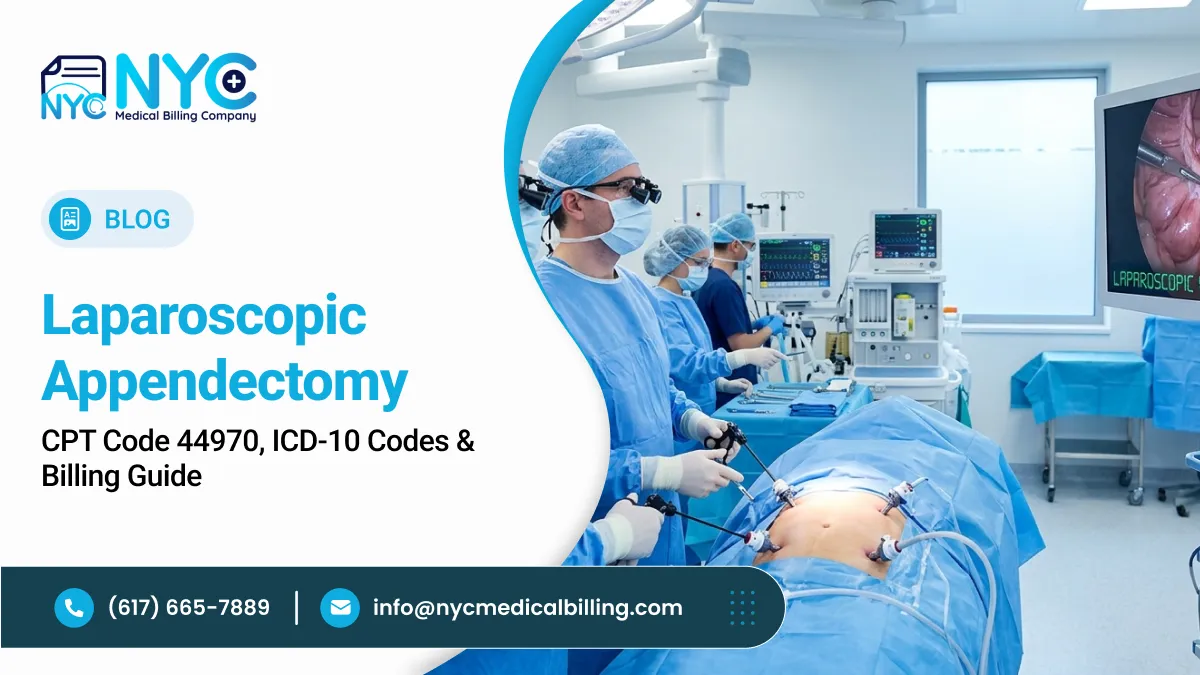
Laparoscopic appendectomy is a minimally invasive surgical procedure used to remove the appendix through small abdominal incisions using laparoscopic instruments and a camera. For billing purposes, the procedure is reported using CPT procedure codes based on the documented surgical approach and diagnosis coding must reflect the confirmed condition treated.
Unlike open appendectomy, laparoscopic surgery generally involves:
- Small trocar incisions
- Abdominal insufflation with carbon dioxide
- Visualization using a laparoscope
- Removal and extraction of the appendix
- Closure of surgical access sites
The procedure is commonly performed for:
- Acute appendicitis
- Acute appendicitis with localized peritonitis
- Perforated appendicitis
- Appendiceal abscess in selected cases
- Other documented appendix-related conditions
From a coding perspective, the procedure code identifies what service was performed, while ICD-10-CM diagnosis codes explain why the procedure was medically necessary.
Both elements must match the operative documentation.
Clinical Role of Laparoscopic Appendectomy in Surgical Practice
Laparoscopic appendectomy is used frequently for general surgery because it allows the surgeon to perform appendix removal without a large incision in the abdomen. Benefits may include better visualization of the abdominal cavity and possible shorter recuperation time and smaller cuts than traditional (open) surgery.
The surgical decision depends on multiple clinical factors, including:
- Patient condition
- Severity of appendicitis
- Presence of perforation
- Abscess formation
- Surgeon judgment
- Hospital protocols
- Available resources
The operative report should clearly describe the clinical findings and procedure details because these elements influence coding accuracy.
Important documentation elements include:
- Confirmed diagnosis
- Surgical approach
- Operative findings
- Presence or absence of perforation
- Presence of abscess or peritonitis
- Specimen removal
- Complications, if any
- Additional procedures performed
CPT Coding for Laparoscopic Appendectomy
The primary CPT code for reporting laparoscopic appendectomy is
CPT 44970 is generally used when the surgeon performs a laparoscopic surgical removal of the appendix.
The documentation should support:
- Laparoscopic approach
- Appendectomy performed
- Surgical removal of appendix
Understanding CPT Reporting Requirements
Coding professionals should not select CPT codes based only on the diagnosis. The procedure code must come from the documented surgical service.
For example:
Documentation:
“Laparoscopic removal of appendix performed for acute appendicitis.”
Possible procedure reporting:
- CPT 44970 Laparoscopic appendectomy
But if the operative note does mention an altered technique or another surgery that the doctor performed, then the coding would need further analysis.
ICD-10-CM Diagnosis Coding for Appendicitis Related to Laparoscopic Appendectomy
The diagnosis code depends on the documented type of appendicitis.
Appendicitis coding requires attention to:
- Acute versus chronic condition
- Perforation status
- Abscess formation
- Peritonitis
- Other specified appendix conditions
The surgeon’s final diagnosis documentation determines the appropriate ICD-10-CM selection.
ICD-10-CM Appendicitis Coding Reference Table
| Clinical Scenario | ICD-10-CM Code Category | Description |
|---|---|---|
| Acute appendicitis without perforation, localized peritonitis, or abscess | K35.80 | Acute appendicitis without perforation, without localized peritonitis, without abscess |
| Acute appendicitis with localized peritonitis without perforation or abscess | K35.30 | Acute appendicitis with localized peritonitis, without perforation or abscess |
| Acute appendicitis with perforation and localized peritonitis | K35.32 | Acute appendicitis with perforation and localized peritonitis, without abscess |
| Acute appendicitis with perforation and abscess | K35.33 | Acute appendicitis with perforation and localized peritonitis with abscess |
| Acute appendicitis with generalized peritonitis | K35.20/K35.21 | Acute appendicitis with generalized peritonitis depending on documentation |
| Other appendicitis | K36 | Other appendicitis |
| Unspecified appendicitis | K37 | Unspecified appendicitis |
Note: ICD-10-CM code selection must be confirmed against the current official code set for the patient’s date of service.
How to Select the Correct Diagnosis Code for Laparoscopic Appendectomy Claims
1. Start With the Provider’s Final Diagnosis
Coders should begin with the surgeon’s documented diagnosis, usually found in:
- Operative report
- Discharge summary
- Progress notes
- Final diagnosis statement
Coders should not assign appendicitis severity based only on:
- CT findings
- Laboratory results
- Pathology reports
- Clinical indicators
The provider must document the diagnosis.
2. Identify the Specific Type of Appendicitis
Appendicitis documentation should clarify:
- Acute appendicitis
- Chronic appendicitis
- Perforated appendicitis
- Appendicitis with abscess
- Appendicitis with peritonitis
Example:
Less specific:
“Appendicitis.”
More specific:
“Acute perforated appendicitis with localized peritonitis and abscess.”
The second documentation example supports more accurate ICD-10-CM code assignment.
3. Determine Whether Perforation Is Present
Perforation significantly affects diagnosis coding.
Documentation should clearly state:
- Whether rupture occurred
- Whether abscess was present
- Whether peritonitis existed
Coders should not assume perforation from:
- Drain placement
- Antibiotic use
- Imaging alone
4. Review Operative Findings
The operative report may include important information such as:
- Inflamed appendix
- Gangrenous appendix
- Perforated appendix
- Purulent fluid
- Abscess cavity
However, coding requires provider documentation supporting the diagnosis.
If clinical findings suggest a more specific condition but documentation does not clearly state it, a compliant provider query may be appropriate.
Documentation Checklist for Laparoscopic Appendectomy
Strong documentation supports accurate coding, medical necessity, reimbursement, and audit defense.
| Documentation Element | Why It Matters |
|---|---|
| Final diagnosis | Supports ICD-10-CM assignment |
| Surgical approach | Supports CPT reporting |
| Acute or chronic status | Determines diagnosis specificity |
| Perforation status | Changes code selection |
| Abscess documentation | Supports complication coding |
| Peritonitis status | Affects ICD-10-CM selection |
| Operative findings | Supports clinical validation |
| Procedure details | Supports billing accuracy |
| Complications | Determines additional reporting needs |
Documentation Examples
Weak Documentation
Appendix removed laparoscopically for appendicitis.
Problem:
The diagnosis lacks specificity regarding severity, perforation, abscess, or peritonitis.
Better Documentation
Laparoscopic appendectomy performed for acute appendicitis without perforation or abscess.
Benefit:
Supports a more specific ICD-10-CM diagnosis.
Strong Documentation
Laparoscopic appendectomy performed for acute perforated appendicitis with localized peritonitis and abscess formation.
Benefit:
Provides complete clinical detail for accurate coding review.
High-Risk Coding and Billing Issues in Laparoscopic Appendectomy
Perforated Appendicitis Documentation Gaps
Perforation is one of the most common areas where documentation problems occur.
Example:
Clinical scenario:
Patient undergoes laparoscopic appendectomy. Surgeon notes “ruptured appendix” in the operative findings but does not include perforation in the final diagnosis.
Possible issue:
The coder may not have sufficient documentation to assign a perforated appendicitis code.
Best practice:
The surgeon should clearly document the final diagnosis.
Confusing Appendicitis With Peritonitis
Peritonitis should not automatically be assigned because inflammation is present.
Coding depends on provider documentation.
Example:
“Inflamed appendix removed.”
This does not automatically support:
- Generalized peritonitis
- Localized peritonitis
- Perforated appendicitis
Coding From Pathology Results Alone
Pathology may confirm appendicitis, but coders generally cannot replace provider diagnosis documentation with pathology findings alone.
Example:
Pathology states:
“Acute appendicitis.”
The provider documentation should still support the diagnosis being coded.
Practical Laparoscopic Appendectomy Coding Examples
| Clinical Documentation | Coding Approach | Main Coding Point |
|---|---|---|
| Acute appendicitis without complication; laparoscopic removal performed | CPT 44970 + K35.80 | Uncomplicated appendicitis |
| Acute appendicitis with localized peritonitis | CPT 44970 + K35.30 | Peritonitis must be documented |
| Perforated appendix with abscess | CPT 44970 + appropriate K35.33 category | Complication changes diagnosis coding |
| “Appendicitis” only documented | CPT 44970 + K37 if supported | Avoid assuming severity |
| CT shows perforation but provider does not document it | Query consideration | Do not code from imaging alone |
| Appendix removed during emergency surgery | Review diagnosis documentation | Procedure alone does not determine diagnosis |
Common Laparoscopic Appendectomy Coding Mistakes
Using Unspecified Appendicitis Codes When Documentation Is Available
If the provider documents perforation, abscess, or peritonitis, the coding should reflect that specificity.
Assigning Diagnosis Based on Imaging Alone
Radiology findings support clinical decision-making but do not replace provider diagnosis documentation.
Missing Procedure Documentation
Incomplete operative notes may create CPT reporting problems.
The surgical note should clearly describe:
- Approach
- Procedure performed
- Findings
- Complications
Assuming Complications Without Documentation
Coders should not infer:
- Perforation
- Abscess
- Sepsis
- Peritonitis
unless documented according to coding rules.
Best Practices for Clean Laparoscopic Appendectomy Claims
Create Diagnosis-Specific Documentation Templates
EHR templates can encourage surgeons to document:
- Appendicitis type
- Perforation status
- Abscess status
- Peritonitis status
Perform Coding Reviews Before Submission
Healthcare organizations should review:
- CPT accuracy
- ICD-10-CM specificity
- Medical necessity support
- Operative documentation
Use Provider Queries Appropriately
A compliant query may be needed when documentation is incomplete but clinical information suggests clarification is necessary.
Queries should:
- Be non-leading
- Include relevant clinical information
- Allow multiple response options
Laparoscopic Appendectomy Claim Verification Checklist
Verification ItemComplete
Provider documented final diagnosis✓
CPT matches documented surgical approach✓
ICD-10-CM code matches diagnosis specificity✓
Perforation status reviewed✓
Abscess documentation reviewed✓
Peritonitis documentation reviewed✓
Medical necessity supported✓
Code validity confirmed for date of service✓
Payer requirements reviewed✓
Frequently Asked Questions
What CPT code is used for laparoscopic appendectomy?
The primary CPT code for laparoscopic appendectomy is 44970. The operative documentation must support that a laparoscopic surgical appendectomy was performed.
What ICD-10 code is commonly used for acute appendicitis?
The ICD-10-CM code depends on documentation. Acute appendicitis without perforation or abscess may fall under K35.80, while complicated cases require more specific codes.
Can coders assign perforated appendicitis from CT findings?
No. Coders should not assign perforated appendicitis solely from imaging results. The provider must document the diagnosis.
Does laparoscopic appendectomy always use CPT 44970?
Most laparoscopic appendectomy procedures are reported with CPT 44970, but coding should always follow the documented procedure performed.
If code correctly will i get paid?
When should provider query for appendectomy claim?
Can I let pathology determine the ICD-10-CM diagnosis?
What causes denials in laparoscopic appendectomy visits?