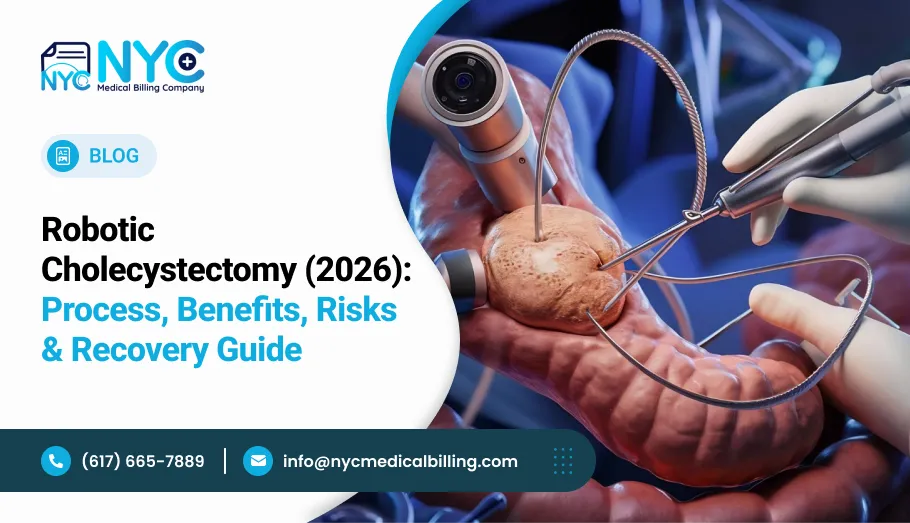
Robotic cholecystectomy is a minimally invasive operation used to remove the gallbladder with the help of a surgeon-controlled robotic surgical system. Although the clinical goal is straightforward, the procedure can become more complicated from a coding and billing perspective. The diagnosis may involve gallstones, acute or chronic cholecystitis, bile duct stones, obstruction, pancreatitis, or another biliary condition. The operative note may also document cholangiography, common bile duct exploration, subtotal removal, or conversion to an open procedure.
These details affect code selection. A routine robot-assisted laparoscopic gallbladder removal may fall under CPT 47562, while procedures involving cholangiography or common bile duct exploration can require 47563 or 47564. Hospital inpatient claims add another layer because ICD-10-PCS, rather than CPT, is used to report inpatient facility procedures. Diagnosis coding must also reflect the exact condition documented by the provider.
This guide explains the robotic cholecystectomy process, common reasons for surgery, benefits, risks, recovery, 2026 CPT coding, ICD-10-CM diagnosis codes, ICD-10-PCS procedure coding, MS-DRG considerations, documentation requirements, and billing mistakes that can lead to denials.
Coding notice: This article is for general educational purposes. Code selection depends on the operative report, diagnosis, treatment setting, date of service, payer rules, and current official code sets. Always verify CPT, ICD-10-CM, ICD-10-PCS, NCCI edits, CMS guidance, and payer-specific policies before submitting a claim.
What Is Robotic Cholecystectomy?
Robotic cholecystectomy is a minimally invasive surgical procedure in which a surgeon removes the gallbladder while controlling robotic surgical instruments from a console. The robotic system does not perform the surgery independently. The surgeon remains in direct control of the instruments throughout the procedure.
Robotic surgical systems can provide a three-dimensional view of the surgical field and allow the surgeon to control articulated instruments through small incisions. The FDA lists gallbladder removal among procedures that may be performed with robotically assisted surgical systems.
From a billing standpoint, the word “robotic” should not automatically drive the base procedure code. The coder must determine what operation was actually performed. For a typical robot-assisted laparoscopic cholecystectomy, the professional procedure is selected from the laparoscopic cholecystectomy CPT family based on whether cholangiography or common bile duct exploration was performed. CMS identifies 47562, 47563, and 47564 as the laparoscopic cholecystectomy family.
Which 2026 Code Set Applies?
Coding teams need to pay close attention to the date of service or discharge because ICD-10 follows the federal fiscal-year cycle rather than the calendar year.
For encounters and discharges from April 1 through September 30, 2026, CMS directs providers to use the April 1, 2026 FY2026 ICD-10-CM and ICD-10-PCS files. Beginning October 1, 2026, FY2027 ICD-10-CM and ICD-10-PCS updates take effect.
This distinction matters for an article labeled “2026.” A surgery performed in August 2026 and one performed in November 2026 occur in the same calendar year but use different fiscal-year ICD-10 releases.
CPT reporting follows the applicable CPT year and payer policy. Coders should verify the active code descriptor, edits, fee schedule, and coverage requirements for the actual date of service rather than relying on an old charge master.
Why Is Robotic Cholecystectomy Performed?
Cholecystectomy is commonly performed when gallbladder disease causes symptoms or complications. Gallstones are one of the major reasons. NIDDK states that surgical removal of the gallbladder is the usual treatment when gallstones require treatment.
Patients considered for gallbladder removal may have conditions such as:
- Symptomatic gallstones
- Acute cholecystitis
- Chronic cholecystitis
- Recurrent biliary pain
- Gallbladder obstruction
- Gallbladder and bile duct stones
- Complicated cholecystitis
- Gallbladder gangrene or perforation
- Certain other documented gallbladder disorders
- Biliary pancreatitis associated with gallstones
The final diagnosis must come from the treating provider. ICD-10-CM guidelines stress that accurate coding depends on complete documentation and that the provider is responsible for establishing the diagnosis.
For example, an ultrasound showing gallstones does not give the coder permission to independently diagnose acute cholecystitis. Likewise, an abnormal gallbladder study should not automatically be converted into a diagnosis that the surgeon did not document.
How Is a Robotic Cholecystectomy Performed?
The exact technique varies with the patient’s anatomy, disease severity, surgeon preference, and robotic platform. However, a typical robot-assisted minimally invasive procedure follows the general principles of laparoscopic gallbladder removal.
1. General anesthesia is administered
The patient is typically under general anesthesia for gallbladder removal. Standard laparoscopic cholecystectomy is performed with the patient asleep and pain-free during the procedure.
2. Small abdominal incisions are created
Small incisions provide access to the abdominal cavity. In standard laparoscopic surgery, several small openings are used for the camera and surgical instruments. Gas is introduced to create working space inside the abdomen.
With robotic surgery, the robotic instruments and camera are introduced through minimally invasive access points, and the surgeon controls them from the surgical console.
3. The gallbladder is identified and dissected
The surgeon identifies the gallbladder and surrounding anatomy before separating the gallbladder from its attachments. Safe identification of the relevant biliary structures is a critical part of the operation.
The operative report should clearly document the surgical approach and whether the entire gallbladder or only part of it was removed. That distinction becomes particularly important for ICD-10-PCS inpatient coding because complete removal is classified differently from partial removal.
4. Cholangiography may be performed
An intraoperative cholangiogram may be performed to evaluate the biliary ducts. During conventional laparoscopic surgery, contrast can be introduced into the ductal system and imaging obtained to look for stones or other biliary findings.
This is also an important CPT distinction. A laparoscopic cholecystectomy with cholangiography is not reported the same way as a routine laparoscopic cholecystectomy without it.
5. Common bile duct stones may require additional work
If stones are identified in the common bile duct, further exploration or removal may be performed when clinically appropriate. The operative note must clearly describe this additional work because CPT 47564 represents a different level of procedure than 47562 or 47563. CMS recognizes 47564 as laparoscopic gallbladder removal involving exploration of the common bile duct.
6. The gallbladder is removed
After the necessary structures have been controlled and divided, the gallbladder is removed through one of the access sites.
If the procedure cannot safely be completed using the minimally invasive approach, the surgeon may convert to open surgery.
Conversion has major coding implications, especially because CPT and ICD-10-PCS handle the situation differently.
Potential Benefits of Robotic Cholecystectomy
Robotic systems offer technical features that may assist the surgeon, including a three-dimensional view and articulated instruments controlled from a console. The FDA notes that robotically assisted systems may help facilitate minimally invasive surgery and assist with complex tasks in confined anatomical areas.
For the patient, many commonly discussed benefits are actually benefits of the minimally invasive approach in general, rather than benefits proven to be unique to robotic surgery. Laparoscopic gallbladder removal commonly allows outpatient treatment and a faster return to normal activity than open surgery.
The evidence comparing robotic and standard laparoscopic cholecystectomy remains mixed. A recent systematic review found similar surgical success, overall complication rates, hospital stay, readmission, and major bile duct injury between the approaches, while reporting fewer conversions to open surgery but longer operating times with robotic procedures.
Other research has raised safety questions. A large Medicare cohort study found a higher rate of bile duct injury requiring definitive repair among robotic procedures than conventional laparoscopic procedures. Because study designs, patient populations, surgeon experience, and case selection differ, robotic surgery should not automatically be described as clinically superior.
For patient education, a more accurate statement is that robotic cholecystectomy is one minimally invasive surgical option, and the choice should consider the patient’s condition and the surgeon’s experience with the technique.
Risks of Robotic Cholecystectomy
Robotic assistance does not remove the usual risks associated with anesthesia or gallbladder surgery.
Potential risks include:
- Bleeding
- Infection
- Reactions to anesthesia or medications
- Blood clots
- Injury to blood vessels near the liver
- Common bile duct injury
- Bowel injury
- Pancreatitis
- Bile leak
- Need for another procedure
- Conversion to open surgery
MedlinePlus specifically lists bleeding, infection, injury to the common bile duct, injury to the small intestine or colon, and pancreatitis among possible risks of gallbladder surgery.
The risk profile is not identical for every patient. Acute inflammation, scarring, altered anatomy, prior abdominal surgery, bile duct disease, and other clinical factors may affect the difficulty of the operation.
Robotic Cholecystectomy Recovery
Recovery depends on the patient’s health, disease severity, complications, and whether the operation remains minimally invasive.
Many laparoscopic cholecystectomies are performed on an outpatient basis, and uncomplicated patients may return to normal physical activity in roughly a week. Open cholecystectomy generally involves a longer hospital stay and a longer return-to-activity period.
Patients may initially experience abdominal soreness, fatigue, or temporary changes in bowel habits. NIDDK notes that a small number of people experience softer or more frequent stools after gallbladder removal, with these changes usually being temporary.
Recovery instructions should always come from the treating surgical team. A complicated cholecystectomy, common bile duct exploration, infection, drain placement, or conversion to open surgery can substantially change the expected recovery period.
Robotic Cholecystectomy CPT Codes for 2026
For physician and applicable outpatient procedure reporting, the central CPT codes are based on the surgical work performed rather than simply on the presence of a robotic system.
| CPT/HCPCS Code | Procedure Situation | Coding Point |
|---|---|---|
| 47562 | Laparoscopic cholecystectomy | Routine laparoscopic gallbladder removal without cholangiography or common bile duct exploration |
| 47563 | Laparoscopic cholecystectomy with cholangiography | Use when intraoperative cholangiography is included and documented |
| 47564 | Laparoscopic cholecystectomy with common bile duct exploration | Use when common bile duct exploration is performed as part of the laparoscopic procedure |
| 47600-47620 | Open cholecystectomy family | Review the exact open procedure documented if the operation is performed open or converted to open |
| S2900 | Robotic surgical assistance | May appear in some payer workflows; it should not be assumed to produce separate reimbursement |
CMS sources identify 47562 through 47564 as the laparoscopic cholecystectomy family. CMS’s 2026 NCCI manual also addresses cholecystectomy coding and related bundling rules.
Does robotic cholecystectomy have its own CPT code?
There is no separate base cholecystectomy CPT code simply because the operation is robotic. The operative service is classified according to what the surgeon actually performed.
For example:
- Robotic-assisted laparoscopic gallbladder removal without cholangiography generally points to 47562.
- If cholangiography is performed, 47563 may apply.
- If common bile duct exploration is performed, 47564 may apply.
The documentation must support the service selected.
What about HCPCS S2900?
HCPCS S2900 has been used in connection with robotic surgical systems, but coverage and reimbursement are payer-specific. Its presence should not be interpreted as a guarantee that a payer will separately reimburse robotic assistance. CMS contractor materials continue to reference S2900 in robotic-assistance discussions, illustrating why organizations need to check the applicable payer’s current policy.
Billing teams should never add an ancillary robotic code simply because the facility owns or used a robot.
ICD-10-CM Diagnosis Codes Related to Cholecystectomy
The diagnosis code should explain why the patient required the procedure, not how the procedure was performed.
The K80 family provides detailed combination codes for gallstones based on the location of the stone, presence and type of inflammation, and whether obstruction is present. CMS listings confirm the following distinctions.
| ICD-10-CM Code | Documented Condition |
| K80.00 | Gallbladder stone with acute cholecystitis, no obstruction |
| K80.01 | Gallbladder stone with acute cholecystitis and obstruction |
| K80.10 | Gallbladder stone with chronic cholecystitis, no obstruction |
| K80.11 | Gallbladder stone with chronic cholecystitis and obstruction |
| K80.12 | Gallbladder stone with acute and chronic cholecystitis, no obstruction |
| K80.13 | Gallbladder stone with acute and chronic cholecystitis and obstruction |
| K80.18 | Gallbladder stone with another form of cholecystitis, no obstruction |
| K80.19 | Gallbladder stone with another form of cholecystitis and obstruction |
| K80.20 | Gallbladder stone without cholecystitis or obstruction |
| K80.21 | Gallbladder stone without cholecystitis, with obstruction |
| K80.30-K80.37 | Bile duct stone with different forms of cholangitis and obstruction status |
| K80.40-K80.47 | Bile duct stone with cholecystitis, differentiated by type and obstruction |
| K80.50 | Bile duct stone without cholangitis/cholecystitis or obstruction |
| K80.51 | Bile duct stone without cholangitis/cholecystitis, with obstruction |
| K80.60-K80.67 | Gallbladder and bile duct stones with forms of cholecystitis and obstruction status |
| K80.70 | Gallbladder and bile duct stones without cholecystitis or obstruction |
| K80.71 | Gallbladder and bile duct stones without cholecystitis, with obstruction |
| K80.80 | Other cholelithiasis without obstruction |
| K80.81 | Other cholelithiasis with obstruction |
These codes should not be selected merely because the patient has “gallstones” somewhere in the record. Location, cholecystitis type, and obstruction can materially change the final code.
Cholecystitis and other gallbladder diagnosis codes
When the provider documents cholecystitis or another gallbladder disorder without a more appropriate combination code from K80, other codes may become relevant.
| Code | Condition |
| K81.0 | Acute cholecystitis |
| K81.1 | Chronic cholecystitis |
| K81.2 | Acute with chronic cholecystitis |
| K81.9 | Unspecified cholecystitis |
| K82.0 | Gallbladder obstruction |
| K82.1 | Hydrops of gallbladder |
| K82.2 | Gallbladder perforation |
| K82.3 | Gallbladder fistula |
| K82.4 | Cholesterolosis of gallbladder |
| K82.8 | Other specified gallbladder disease |
| K82.9 | Unspecified gallbladder disease |
| K82.A1 | Gangrene of gallbladder associated with cholecystitis |
| K82.A2 | Gallbladder perforation associated with cholecystitis |
CMS code listings confirm these K81 and K82 categories.
A condition such as biliary dyskinesia should not automatically be assigned to K82.8 from a test result alone. The coder should follow the Alphabetic Index, Tabular List, and provider’s documented diagnosis.
Biliary and pancreatic diagnoses that may also matter
Some patients undergoing gallbladder treatment have associated bile duct or pancreatic disease. Examples include:
- K83.09 for other cholangitis
- K83.1 for bile duct obstruction
- K85.10 for biliary acute pancreatitis without necrosis or infection
- K85.11 for biliary acute pancreatitis with uninfected necrosis
- K85.12 for biliary acute pancreatitis with infected necrosis
CMS listings include these biliary and pancreatitis diagnoses.
These should be reported only when supported by the record and applicable coding rules.
ICD-10-PCS Codes for Inpatient Robotic Cholecystectomy
ICD-10-PCS is used for hospital inpatient procedure reporting. It is not a substitute for CPT on professional claims.
A complete laparoscopic removal of the gallbladder uses the PCS root operation Resection, because the entire body part is removed. The 2026 PCS guidelines define resection around removal of the entire applicable body part, while partial removal is classified as Excision.
Important PCS codes include:
| ICD-10-PCS Code | Meaning |
| 0FT44ZZ | Complete removal of gallbladder, percutaneous endoscopic approach |
| 0FB44ZZ | Partial removal/excision of gallbladder, percutaneous endoscopic approach |
| 0FT40ZZ | Complete removal of gallbladder, open approach |
| 0FJ44ZZ | Inspection of gallbladder, percutaneous endoscopic approach |
| 8E0W4CZ | Robotic-assisted procedure of trunk region, percutaneous endoscopic approach |
CMS’s FY2026 MS-DRG manual includes 0FT44ZZ, 0FB44ZZ, and 0FT40ZZ among gallbladder procedures, and current FY2026 materials identify 0FJ44ZZ as percutaneous-endoscopic inspection of the gallbladder.
CMS PCS mapping identifies 8E0W4CZ for a laparoscopic robot-assisted procedure involving the trunk region. The principal surgical procedure still needs to be coded separately.
Total versus subtotal cholecystectomy
This distinction is easy to miss.
If the entire gallbladder is removed through a percutaneous-endoscopic approach, 0FT44ZZ generally represents the PCS concept of resection.
If only part of the gallbladder is removed, as in a documented subtotal cholecystectomy, the coder should evaluate 0FB44ZZ, which represents excision rather than complete resection.
Do not select Resection simply because the surgeon calls the operation a “cholecystectomy.” The body of the operative report must establish what was actually removed.
What Happens When Laparoscopic Surgery Converts to Open?
This is one of the most important billing differences between CPT and ICD-10-PCS.
CPT reporting
CMS’s 2026 NCCI manual states that when a laparoscopic procedure is converted to an open procedure, only the open procedure should be reported. The laparoscopic procedure is not separately reported with the open code.
The coder should select the appropriate open cholecystectomy code from the relevant CPT family based on the actual work documented.
ICD-10-PCS inpatient reporting
PCS handles the same scenario differently.
The FY2026 ICD-10-PCS guidelines specifically use a laparoscopic cholecystectomy converted to open surgery as an example. The guidance says to code the attempted percutaneous-endoscopic Inspection and the completed open Resection.
For a complete gallbladder removal, that may involve:
- 0FJ44ZZ for percutaneous-endoscopic inspection of the gallbladder
- 0FT40ZZ for open resection of the gallbladder
This is why copying codes from the professional claim to the inpatient facility record is inappropriate.
2026 MS-DRG Considerations
For inpatient hospital payment, the final MS-DRG depends on the full coded record, not merely the fact that a cholecystectomy occurred.
The FY2026 CMS MS-DRG framework includes:
| MS-DRG | General Classification |
| 411 | Cholecystectomy with common duct exploration, with MCC |
| 412 | Cholecystectomy with common duct exploration, with CC |
| 413 | Cholecystectomy with common duct exploration, without CC/MCC |
| 414 | Non-laparoscopic cholecystectomy without common duct exploration, with MCC |
| 415 | Non-laparoscopic cholecystectomy without common duct exploration, with CC |
| 416 | Non-laparoscopic cholecystectomy without common duct exploration, without CC/MCC |
| 417 | Laparoscopic cholecystectomy without common duct exploration, with MCC |
| 418 | Laparoscopic cholecystectomy without common duct exploration, with CC |
| 419 | Laparoscopic cholecystectomy without common duct exploration, without CC/MCC |
CMS’s FY2026 v43.1 manual lists these DRGs and distinguishes cholecystectomy by common duct exploration, laparoscopic status, and CC/MCC level.
These are not codes that should be manually assigned from one diagnosis or one procedure alone. The hospital grouper uses the complete inpatient record.
Documentation Checklist for Robotic Cholecystectomy
Good documentation supports both clinical continuity and accurate reimbursement.
| ✓ Documentation Item |
| ✔ Final gallbladder or biliary diagnosis |
| ✔ Presence and location of gallstones |
| ✔ Acute, chronic, or acute-on-chronic cholecystitis |
| ✔ Whether obstruction is present |
| ✔ Associated bile duct disease |
| ✔ Robotic/laparoscopic/open approach |
| ✔ Whether complete or subtotal cholecystectomy was performed |
| ✔ Intraoperative cholangiography, when performed |
| ✔ Common bile duct exploration, when performed |
| ✔ Conversion from minimally invasive to open surgery |
| ✔ Reason for conversion, when applicable |
| ✔ Intraoperative findings and complications |
| ✔ Additional clinically significant diagnoses |
| ✔ Postoperative treatment and disposition |
Complete documentation is central to ICD-10-CM coding. The FY2026 official guidelines emphasize that accurate code assignment cannot be achieved without consistent, complete documentation.
Weak documentation
Gallstones. Robotic gallbladder surgery performed.
This wording does not establish whether cholecystitis or obstruction was present. It also fails to clarify whether cholangiography, common duct exploration, or complete versus subtotal removal occurred.
Better documentation
Symptomatic cholelithiasis without cholecystitis or obstruction. Robotic-assisted laparoscopic cholecystectomy completed without cholangiography or common bile duct exploration.
This supports a much clearer clinical and procedural coding path.
Strong documentation
Acute calculous cholecystitis without obstruction. Robotic-assisted laparoscopic complete cholecystectomy performed. Intraoperative cholangiography completed. No common bile duct exploration and no conversion to open surgery.
This note identifies the disease, obstruction status, surgical approach, extent of removal, and additional intraoperative service.
High-Risk Robotic Cholecystectomy Billing Rules
Do not change the base CPT simply because a robot was used
Code the operation performed. The key distinction between 47562, 47563, and 47564 is the additional surgical work, not the brand or presence of the robotic platform.
Do not bill diagnostic laparoscopy with the completed surgical laparoscopy
CMS’s 2026 NCCI manual states that surgical laparoscopy includes diagnostic laparoscopy. When diagnostic laparoscopy leads to a surgical laparoscopic procedure during the same encounter, only the surgical laparoscopy is generally reported.
Do not automatically use 47563 because imaging occurred
The operative record needs to support intraoperative cholangiography. A preoperative ultrasound, CT, MRCP, or another diagnostic study does not convert a routine cholecystectomy into CPT 47563.
Do not automatically use 47564 for a bile duct diagnosis
A patient may have choledocholithiasis without the surgeon performing laparoscopic common bile duct exploration. The diagnosis alone does not establish the procedure.
Do not assume robotic assistance is separately payable
A robotic-assistance code may be handled differently among payers. Confirm payer requirements before placing S2900 or another ancillary code on the claim.
Do not separately report an included diagnostic laparoscopy after conversion
For CPT/NCCI purposes, CMS states that when a laparoscopic procedure converts to open, only the open procedure is reported rather than both the laparoscopic and open surgical codes.
Robotic Cholecystectomy Coding Examples
| Clinical Documentation | Possible Coding Approach | Main Point |
| Symptomatic gallbladder stones without cholecystitis or obstruction; robotic laparoscopic removal | K80.20 + CPT 47562 | Diagnosis and procedure both support uncomplicated gallstone removal |
| Gallstones with acute cholecystitis, no obstruction; robotic laparoscopic removal | K80.00 + CPT 47562 | Use combination diagnosis when supported |
| Gallstones with chronic cholecystitis and obstruction | K80.11 plus applicable procedure code | Obstruction changes ICD-10 specificity |
| Robotic laparoscopic cholecystectomy with cholangiography | CPT 47563 | Cholangiography changes the procedure code |
| Laparoscopic cholecystectomy with common bile duct exploration | CPT 47564 | Common duct exploration must be documented |
| Inpatient complete robotic laparoscopic cholecystectomy | 0FT44ZZ plus robotic-assistance coding when applicable | PCS uses Resection for total removal |
| Inpatient robotic subtotal cholecystectomy | Evaluate 0FB44ZZ plus applicable robotic-assistance coding | Partial removal is Excision, not total Resection |
| Laparoscopic procedure converted to complete open gallbladder removal | CPT: applicable open code; PCS: 0FJ44ZZ + 0FT40ZZ when supported | CPT and PCS apply different conversion rules |
These are simplified educational examples. The correct sequencing and final code set depend on the complete record, encounter setting, payer, and all additional diagnoses and procedures. CMS’s current guidance should be checked for the applicable date.
Can Cholecystitis or Gallstones Be Coded From Imaging Alone?
Coders should not independently establish a clinical diagnosis from imaging, laboratory values, or another test when provider documentation is required.
The official FY2026 ICD-10-CM guidelines explain that the provider is the professional legally accountable for establishing the patient’s diagnosis and stress the importance of reviewing the complete record.
An ultrasound report may state that stones are present. A HIDA scan may contain abnormal findings. Laboratory results may show elevated liver enzymes. These findings can support clinical decision-making, but the coder should follow official coding rules regarding what documentation can establish the reportable diagnosis.
If the operative record and other documentation conflict about the diagnosis, a compliant provider query may be appropriate rather than making an unsupported assumption.
Common Robotic Cholecystectomy Coding Mistakes
Using K81.0 when a more complete gallstone combination code is documented
If the provider documents gallstones with acute cholecystitis, a K80 combination code may capture both conditions and obstruction status more accurately than coding cholecystitis alone. CMS’s code set provides specific K80 combinations for these scenarios.
Ignoring obstruction status
K80 codes frequently distinguish between “with obstruction” and “without obstruction.” Missing this detail can lead to an unspecified or incorrect code.
Confusing total and subtotal removal
This mistake matters mainly for inpatient ICD-10-PCS. Complete removal is represented by Resection, while partial removal is represented by Excision under PCS root-operation rules.
Reporting both laparoscopic and open CPT procedures after conversion
CMS’s 2026 NCCI rules specifically instruct that only the open procedure be reported when a laparoscopic procedure is converted to open.
Missing cholangiography documentation
Do not move from 47562 to 47563 unless the operative documentation supports the cholangiography component.
Confusing cholangiography with common bile duct exploration
These represent different operative work. CPT 47563 relates to cholangiography, while 47564 involves common bile duct exploration.
Treating “robotic” as the principal coding decision
The underlying cholecystectomy remains the core operation. Robot use is an assistance/technology detail and should not replace coding the actual surgical objective.
Using the wrong fiscal-year ICD-10 files
A September 2026 encounter falls under the applicable FY2026 files, while an October 2026 encounter falls under FY2027. CMS has already published the October 1, 2026 update files.
Best Practices for Clean Robotic Cholecystectomy Claims
Match the diagnosis to the operative findings
Review the surgeon’s preoperative and postoperative diagnoses, operative findings, discharge documentation, and pathology information as allowed by applicable coding rules.
Confirm whether the record supports gallstones, cholecystitis, obstruction, bile duct involvement, or another gallbladder condition.
Match CPT to the actual additional work
Ask three practical questions:
- Was the gallbladder removed laparoscopically?
- Was intraoperative cholangiography performed?
- Was the common bile duct explored?
These answers help distinguish 47562, 47563, and 47564.
Separate professional CPT logic from inpatient PCS logic
A professional claim and inpatient facility claim do not use the same procedure coding system.
CPT describes physician and applicable outpatient services. ICD-10-PCS classifies inpatient hospital procedures.
Build conversion fields into the operative template
A structured operative template should make it easy to document:
- Initial approach
- Final approach
- Reason for conversion
- Complete versus subtotal removal
- Cholangiography
- Common duct exploration
- Robotic assistance
- Complications
This reduces the need for retrospective coding queries.
Review NCCI before submitting separately billed services
The 2026 NCCI manual states that diagnostic laparoscopy is included in surgical laparoscopy and establishes other bundling principles for abdominal procedures.
A service being documented does not automatically mean it is separately reportable.
Robotic Cholecystectomy Claim Verification Checklist
| ✓ Verification Item |
| ✔ Final gallbladder diagnosis is documented |
| ✔ Gallstone location is identified when known |
| ✔ Acute/chronic cholecystitis status is captured |
| ✔ Obstruction status is documented |
| ✔ Appropriate K80 combination code was considered |
| ✔ Surgical approach is clear |
| ✔ Robotic assistance is documented |
| ✔ Total versus subtotal removal is clear |
| ✔ Cholangiography is documented if 47563 is reported |
| ✔ Common bile duct exploration is documented if 47564 is reported |
| ✔ Conversion to open surgery is coded under the correct coding system |
| ✔ Inpatient facility procedure uses ICD-10-PCS rather than CPT |
| ✔ Date-of-service code set has been verified |
| ✔ NCCI edits have been reviewed |
| ✔ Payer-specific robotic-assistance rules have been checked |
| ✔ Diagnosis supports the medical necessity documented in the record |
Frequently Asked Questions
1. What is the CPT code for robotic cholecystectomy?
There is not one separate CPT code used solely because a robot assisted the operation. For a typical robot-assisted laparoscopic cholecystectomy, 47562, 47563, or 47564 may apply depending on whether cholangiography or common bile duct exploration was performed.
2. What is CPT 47562?
47562 represents a laparoscopic surgical cholecystectomy without the additional cholangiography or common bile duct exploration represented by the other codes in the family. CMS includes it within the laparoscopic cholecystectomy code family.
3. What is the difference between CPT 47562 and 47563?
47563 includes intraoperative cholangiography, while 47562 represents laparoscopic cholecystectomy without that additional component. The operative report must support the cholangiography before 47563 is selected.
4. What is CPT 47564 used for?
47564 is associated with laparoscopic cholecystectomy involving exploration of the common bile duct. It should not be selected simply because the patient has bile duct stones; the exploration itself must be performed and documented.
5. What ICD-10 code is used for gallstones without cholecystitis?
K80.20 applies to calculus of the gallbladder without cholecystitis and without obstruction. K80.21 identifies the corresponding condition with obstruction.
6. What is the ICD-10 code for acute cholecystitis?
K81.0 identifies acute cholecystitis. However, when gallstones and acute cholecystitis are documented together, a more specific K80 combination code may apply instead.
7. What ICD-10-PCS code is used for complete laparoscopic gallbladder removal?
0FT44ZZ represents resection of the gallbladder using a percutaneous-endoscopic approach. In PCS terminology, removal of the entire gallbladder is classified as Resection.
8. What PCS code can represent robotic assistance?
CMS PCS mapping identifies 8E0W4CZ for a robot-assisted procedure of the trunk using a percutaneous-endoscopic approach. The underlying surgical procedure still needs its own PCS code.
9. How is a laparoscopic cholecystectomy converted to open coded?
For CPT/NCCI reporting, CMS states that only the open procedure is reported after conversion. For inpatient ICD-10-PCS, the 2026 guidelines give the specific example of coding percutaneous-endoscopic Inspection plus open Resection.
10. Is robotic cholecystectomy safer than standard laparoscopic surgery?
Current research does not establish universal superiority. A recent meta-analysis found broadly similar complication outcomes between approaches, while a large Medicare cohort reported a higher risk of serious bile duct injury with robotic surgery. Patient selection, surgeon experience, and study design affect these comparisons.
11. How long does robotic cholecystectomy recovery take?
Recovery varies, but uncomplicated minimally invasive gallbladder removal often allows a return to normal physical activity in about a week. Open surgery generally requires a longer recovery. Patients should follow the instructions provided by their surgical team.
12. Does S2900 guarantee additional payment for robotic surgery?
No. Robotic-assistance coding and reimbursement can vary by payer. A provider should check the patient’s payer policy rather than assuming that the use of robotic technology creates separate payment.
Conclusion
Robotic cholecystectomy combines minimally invasive gallbladder removal with a surgeon-controlled robotic surgical system. The procedure may be used for gallstones, cholecystitis, obstruction, and other documented gallbladder or biliary conditions. For patients, recovery after an uncomplicated minimally invasive procedure is often much shorter than after open surgery, although individual recovery depends on the clinical situation.
For coding teams, the word “robotic” is only one part of the operative record. CPT selection should reflect whether the procedure was a routine laparoscopic cholecystectomy, included cholangiography, or involved common bile duct exploration. ICD-10-CM should capture the specific disease, including gallstone location, cholecystitis type, and obstruction status when documented.
Hospital inpatient coding requires another level of review. Complete versus subtotal gallbladder removal, robotic assistance, and conversion from a laparoscopic to an open approach can affect ICD-10-PCS coding. CMS also applies different conversion rules to CPT and PCS, making accurate documentation especially important.
Before submitting a 2026 claim, confirm the operative report, diagnosis specificity, procedure setting, NCCI edits, payer requirements, and code set that applies to the actual date of service. That final review can prevent incorrect coding, avoid unnecessary denials, and provide a clearer record of the care actually delivered.